Skills Assessment is the first and most crucial step in the Australian migration pathway. However, many applicants choose to wait until a new allocation is released before starting their Skills Assessment. Is this a wise strategy, or could it unintentionally cause you to miss out on valuable opportunities? Let’s explore the answer together with Skill Direct.
1. What You Need To Know About Allocation
To make the right decision about when to undertake a Skills Assessment, it’s essential to first have a clear understanding of what allocation is.
1.1 What is Allocation?
In the field of Australia migration, allocation refers to the annual quota or number of nomination places that the Australian Government assigns to the skilled migration program in each financial year.
The allocation process takes place at two levels:
The first, federal level:
The Australian Government determines the overall quota for the skilled migration program for the financial year. This serves as the foundation for policy planning and for adjusting strategies to attract skilled workers both onshore and offshore.
The second, state and territory level
Based on the overall quota, the government then distributes specific allocations to individual states and territories such as Victoria, New South Wales, Western Australia, Tasmania, and others. After receiving their quotas, each state assesses local labor shortages and publishes its priority occupation list along with specific nomination criteria.
As a result, allocation plays a decisive role in determining which occupations receive more invitations and which are restricted, directly influencing your migration strategy.
1.2 Timing of Allocation announcement:
There is no fixed schedule for announcing skilled migration quotas within a financial year. When the Australian Government releases new allocations, states and territories require additional time to review workforce needs and finalize their own nomination policies.
Consequently, the opening dates for state nomination applications may vary from state to state and differ from year to year. In some cases, certain states may announce their allocations quite late, depending on economic conditions and actual labor demand.
1.3 Factors affect Allocation:
Annual allocation figures are neither fixed nor random, they are influenced by various socio-economic factors at the state and territory level. Some of the most significant factors include:
Priority workforce needs of each state or territory
Each state has its own economic development strategy, leading to differing workforce demands. For example, some states prioritize engineering and construction occupations to support infrastructure development, while others focus on healthcare or education professionals. As a result, allocations for specific occupations vary according to each state’s priorities in a given financial year.
Backlog of unprocessed applications from previous years
When a large number of applications remain unprocessed, states must allocate resources to clear these backlogs before accepting new applications. This may result in certain occupations temporarily closing or receiving very limited quotas, increasing competition among applicants.
In summary, allocation is the outcome of a complex assessment involving real labor market needs, future development plans, and each state’s administrative capacity. Understanding these factors enables you to plan your migration pathway more proactively rather than passively waiting for new quotas.
2. When Should You Do Skills Assessment?
Because Australia’s skilled migration quotas change from one financial year to another, it is impossible to know exactly when your occupation will be invited, which state will open applications first, or whether the invitation points threshold will increase or decrease. This uncertainty makes the timing of your Skills Assessment extremely important.

2.1 Why should you complete Skills Assessment early?
There are many reasons why completing your Skills Assessment as early as possible gives you a significant advantage. Once you have a positive assessment result, you gain greater control over every stage of your application and are fully prepared to seize opportunities as soon as state or federal programs open.
In practice, immediately after the Australian Government announced the skilled migration allocation for the 2025–26 financial year on 18 November 2025, states moved quickly to release their respective quotas. Notably, Victoria opened its nomination portal for just one single day, highlighting the intense level of competition. Applicants who already had a valid Skills Assessment were able to submit their applications immediately, without losing time on preparation.
Completing your Skills Assessment early also helps you avoid timing risks and reduces vulnerability to sudden policy changes, which can occur at any time. This is particularly critical in an environment where states are increasingly tightening criteria and prioritizing applicants who are fully application-ready.
If you would like a deeper breakdown of each benefit, Skill Direct has previously analyzed this topic in detail. You may refer to those resources to better understand the full role of Skills Assessment in a skilled migration plan.
2.3 Consequences of waiting for Allocation before doing a Skills Assessment
Delaying your Skills Assessment especially in skilled migration pathways can have serious consequences and directly danger your plans to migrate to Australia:
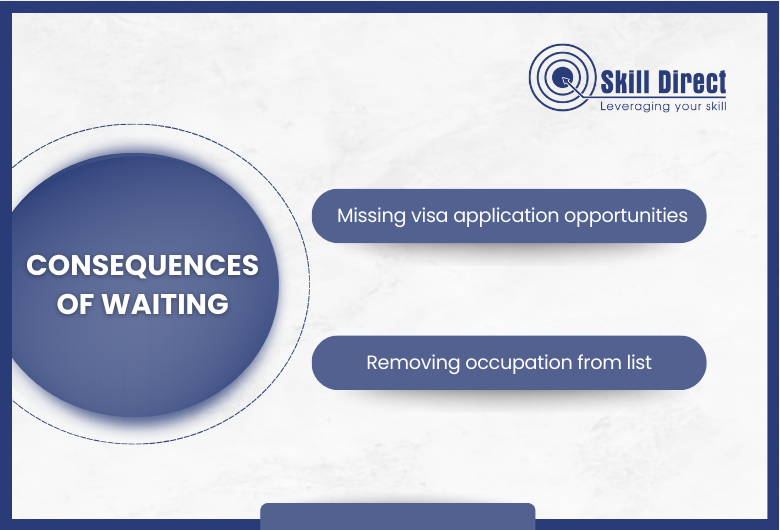
Risk of missing visa application opportunities
Skill Select invitation rounds may occur unexpectedly and do not follow a fixed annual schedule. Without a valid Skills Assessment, you cannot lodge an EOI (Expression of Interest). This means you are automatically excluded from that invitation round, regardless of how high your points score may be.
Similarly, many states and territories open their nomination programs for very short periods and close them as soon as quotas are filled. If your Skills Assessment is not ready, you will be one step behind and may miss the chance to apply particularly for high-demand occupations.
In other words, waiting for allocation before starting your Skills Assessment puts you in a passive position. A delay at this stage can easily result in losing an entire financial year.
Sudden policy changes removing your occupation from the list
Occupation List is regularly reviewed and adjusted by the Australian Government, especially around allocation announcements. These changes can happen quickly and are often difficult to predict.
If you postpone your Skills Assessment and your occupation is removed from the list of in-demand roles, you may lose almost all opportunities to apply under that occupation.
However, if you already hold a valid Skills Assessment, you can act immediately when your occupation is reinstated on the list without further delays or additional preparation time.
3. How to prepare an effective Skills Assessment strategy
In any migration plan, having a well-defined strategy along with contingency options allows you to stay proactive and optimise the Skills Assessment process. Below are the key steps you should closely follow to ensure your application is both effective and competitive:
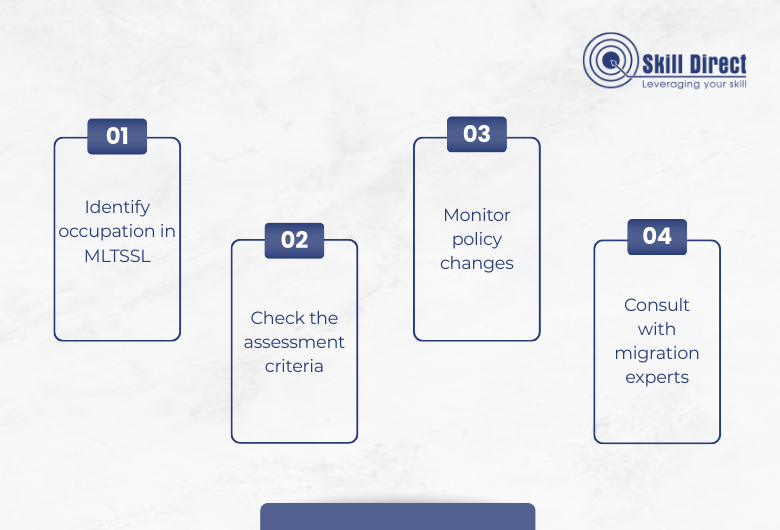
- Identify your occupation on the Occupation List: You must clearly identify the occupation you intend to pursue in your Australian migration plan.
Priority should be given to occupations on the Medium and Long-term Strategic Skills List (MLTSSL), as these roles are more stable, eligible for a wider range of visa subclasses, and offer stronger long-term migration prospects.
In contrast, occupations on the Short-term Skilled Occupation List (STSOL) generally provide fewer opportunities and carry higher risk when policy settings change.
- Check the assessment criteria of each assessing authority: Each occupational group is assessed by a different authority, so the evaluation criteria are not the same.
For example, trade occupations are assessed by Trades Recognition Australia (TRA). In addition to document assessment, TRA often requires practical skills checks such as a technical interview.
In contrast, occupations in the ICT sector are assessed by the Australian Computer Society (ACS), which mainly focuses on document-based assessment and rarely requires direct technical interviews.
Having a clear understanding of the specific assessment criteria of each authority allows you to prepare your documentation thoroughly, avoid unnecessary omissions, and significantly shorten the processing time for your Skills Assessment.
- Monitor policy changes: Program allocations for migration pathways may fluctuate after each invitation round. Therefore, it is essential to regularly update yourself through the official website of the Department of Home Affairs or the official websites of each state or territory to stay informed and make timely adjustments to your points strategy or state nomination choices.
- Consult with migration experts: Instead of handling your application independently and struggling with complex questions, you may choose to work with a professional migration consultant. Partnering with experienced experts at Skill Direct helps you build a clear migration pathway and receive step-by-step guidance throughout the Skills Assessment process, ensuring full compliance with the requirements of the assessing authorities.