



Ministerial Direction 119 is a direction issued by the Minister for Home Affairs under section 499 of the Migration Act 1958. It establishes the order in which certain skilled visa nomination applications and visa applications are to be processed. Ministerial Direction 119 replaces Ministerial Direction 105, which was issued on 14 December 2023. It applies both to applications lodged before the Direction commenced that were still awaiting a final decision and to applications lodged on or after its commencement date.
Importantly, Ministerial Direction 119 only affects the order and timing in which applications are processed. It does not introduce new visa criteria, reduce any existing eligibility requirements or guarantee that an applicant will be granted a visa.

Priority Order Under Ministerial Direction 119
Under Ministerial Direction 119, the highest processing priority is given to applications involving onshore applicants working in law enforcement and defence occupations. The next priority is given to offshore applicants in the same occupational group, followed by onshore applicants working in three other priority sectors: healthcare, teaching and construction. Once these priority groups have been considered, the Department of Home Affairs will process other onshore applications before moving on to the remaining offshore applications.
Applications within the same priority category are treated equally. Therefore, being included in a priority group does not necessarily mean that an application will be processed ahead of every other application within that group.
Four Priority Occupational Groups
1. Law Enforcement and Defence
- ANZSCO Unit Group 4413 - Police
- ANZSCO Unit Group 4411 - Defence Force Members - Other Ranks
It also includes the following ANZSCO occupations:
- 111212 - Defence Force Senior Officer
- 139111 - Commissioned Defence Force Officer
- 139211 - Senior Non-Commissioned Defence Force Member
2. Healthcare
- ANZSCO Sub-Major Group 25 - Health Professionals
- ANZSCO Minor Group 411 - Health and Welfare Support Workers
- ANZSCO Unit Group 2346 - Medical Scientists
- ANZSCO Unit Group 2721 - Counsellors
- ANZSCO Unit Group 2723 - Psychologists
- ANZSCO Unit Group 2725 - Social Workers
- ANZSCO Unit Group 3112 - Medical Technicians
It also includes the following ANZSCO occupations:
- 423111 – Aged or Disabled Carer
- 423312 – Nursing Support Worker
- 423313 – Personal Care Assistant
3. Teaching
- ANZSCO Minor Group 241 - School Teachers
- ANZSCO Unit Group 1341 - Child Care Centre Managers
It also includes the following ANZSCO occupations:
- 134311 – School Principal
- 242211 – Vocational Education Teacher (AUS) / Polytechnic Teacher (NZ)
- 421111 – Child Care Worker
- 242111 – University Lecturer
4. Construction
- ANZSCO Sub-Major Group 33 - Construction Trades Workers
- ANZSCO Sub-Major Group 82 - Construction and Mining Labourers
- ANZSCO Unit Group 1331 - Construction Managers
- ANZSCO Unit Group 2321 - Architects and Landscape Architects
- ANZSCO Unit Group 2332 - Civil Engineering Professionals
- ANZSCO Unit Group 3121 - Architectural, Building and Surveying Technicians
- ANZSCO Unit Group 3126 - Safety Inspectors
- ANZSCO Unit Group 3129 - Other Building and Engineering Technicians
- ANZSCO Unit Group 3222 - Sheetmetal Workers
- ANZSCO Unit Group 3223 - Structural Steel and Welding Trades Workers
- ANZSCO Unit Group 7111 - Clay, Concrete, Glass and Stone Processing Machine Operators
- ANZSCO Unit Group 7121 - Crane, Hoist and Lift Operators
- ANZSCO Unit Group 7212 - Earthmoving Plant Operators
It also includes the following ANZSCO occupations:
- 341111 – Electrician (General)
- 341112 – Electrician (Special Class)
Which Visa Subclasses Are Covered?
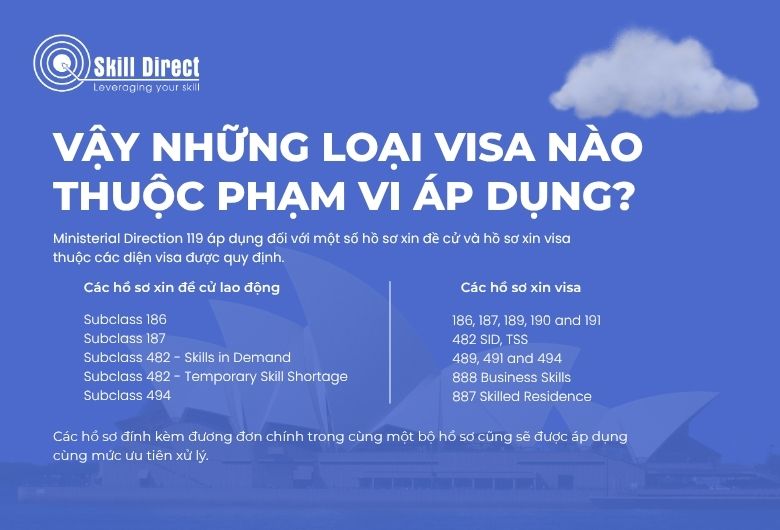
Ministerial Direction 119 applies to nomination applications associated with Subclass 186, Subclass 187, Subclass 482 Skills in Demand, Subclass 482 Temporary Skill Shortage and Subclass 494 visas. It also applies to visa applications under Subclasses 186, 187, 189, 190, 191, 482, including both the Skills in Demand and Temporary Skill Shortage visas, as well as Subclasses 489, 491, 494, 888 and 887 Family members included in the same combined application with the primary applicant will generally receive the same processing priority.
Applications Not Covered by the Direction
Under section 4.3, Ministerial Direction 119 does not apply to applications remitted for reconsideration by the former Administrative Appeals Tribunal or the Administrative Review Tribunal. It also does not apply where the AAT or ART has set aside a previous decision and substituted it with a new decision.
In addition, Direction 119 does not affect the outcome of applications that can be identified at the outset as being unable to satisfy the relevant nomination or visa requirements. The Direction also does not apply to: Applications made by family members who are not included in a combined application with the primary applicant Nomination applications relating to a change of sponsoring employer Review proceedings conducted by the ART itself The ART is not bound by this Ministerial Direction.
Under section 4.4, Direction 119 applies to nomination and visa applications lodged before the Direction commenced where no final decision had yet been made. It also applies to applications lodged on or after its commencement date.
How Does Ministerial Direction 119 Affect Skilled Visa Applications?
Ministerial Direction 119 determines which applications are considered first. It does not change the applicable visa criteria or guarantee that a visa will be granted.
To be granted a visa, applicants must still satisfy all current requirements, including:
- An eligible occupation
- Relevant skills and work experience
- English language proficiency
- Health requirements
- Character Requirement
- Salary requirements, where applicable
- Any other legal criteria applying to the relevant visa subclass
Priority processing under Ministerial Direction 119 only affects the order and timeframe in which an application is assessed. The final decision will continue to depend on whether the applicant meets all applicable legal requirements, based on the documents and supporting evidence provided.
Under Ministerial Direction 119, certain categories of applications may receive priority processing, including applications involving people who are currently living in Australia and working in the health, education, construction, law enforcement or defence sectors.
To find out whether Ministerial Direction 119 may affect your application, contact Skill Direct for professional assistance.