




The answer is YES. However, the process requires significantly more careful preparation. Part-time work is a common option for students and those looking to earn additional income while gaining work experience in Australia. However, given that part-time employment involves fewer working hours than full-time employment, can it still be used for a Skills Assessment?
In this article, Skill Direct explores how part-time employment may be assessed for Skills Assessment purposes and what you should prepare before lodging your application.

1. Understanding the Role of Skills Assessment
Skills assessment is a mandatory requirement for skilled migration pathways in Australia, including independent skilled visas and state-nominated visas such as subclasses 189, 190 and 491. Through skills assessment, the Australian Department of Home Affairs can ensure the quality of skilled migrants and confirm whether applicants have skills that match the needs of the Australian labour market.
Therefore, whether you work full-time or part-time, you may still be eligible to undertake a Skills Assessment Australia. The purpose is for the relevantAssessing Authoritiesto determine whether your part-time work experience is equivalent to the standard expected of a skilled worker in your nominated occupation.
2. When Can Part-Time Experience Be Recognised?
For this reason, you should carefully check the requirements and prepare your documents thoroughly to reduce the risk of your application being rejected.

2.1 Key Requirements and Documents to Prepare
For part-time employment, three key factors can determine the success of your skills assessment application:
- Working hours: Depending on your ANZSCO occupation and assessing authority, there will be specific minimum working hour requirements that you must satisfy.
- Wage level: Your hourly part-time wage should not be lower than the minimum wage required under Australian law or the market rate for a comparable role.
- ANZSCO occupation code: Your actual duties must align with the description of the ANZSCO occupation you intend to nominate. This is a fundamental requirement to avoid refusal due to employment being considered unrelated to your nominated occupation.
You should also prepare supporting documents carefully, including:
- Thư xác nhận công việc Employment reference letter / statement of service on company letterhead, clearly stating your job title, start and end dates, hours worked per week, employment arrangement (part-time/casual), detailed duties, and the name, position and signature of the person providing the reference.
- Employment contract.
- Payslips.
- Tax records and evidence of tax payments.
- Bank statements showing salary payments.
- Identification documents and qualifications.
2.2. Assessing Authorities That May Recognise Part-Time Employment
Part-time and casual employment may be recognised for Skills Assessment purposes. What matters is not simply whether your employment is labelled "part-time" or "casual", but whether it meets the relevant assessing authority's requirements, including minimum working hours and other applicable criteria. Different assessing authorities apply different rules, so there are several important distinctions to consider.

- Assessing authorities with a minimum 20-hour-per-week requirement: For assessing authorities such as IML, ACS and Engineers Australia (EA), employment of at least 20 hours per week may meet the applicable working-hours requirement. Therefore, part-time or casual employment may potentially be recognised where the relevant criteria are satisfied.
- Assessing authorities that distinguish between full-time and part-time employment (TRA): Where Trades Recognition Australia (TRA) distinguishes between full-time and part-time employment,part-time experience may be calculated on a pro-rata basis, with full-time employment generally based on 38 hours per week.. For example: depending on the applicable TRA program and requirements, a period of part-time employment may represent a shorter equivalent period of full-time employment.
- Working in multiple roles at the same time (concurrent employment):
If you hold two or more jobs during the same period, it is important to check whether your assessing authority allows the hours from concurrent employment to be combined.
- VETASSESS may recognise concurrent employment: Where the applicable requirements are met, concurrent employment may be considered in determining whether the required working hours have been satisfied.
- ACS does not simply combine separate jobs to meet the minimum hours requirement: Each employment episode must satisfy the applicable ACS criteria. Therefore, two jobs that individually fall below the required weekly hours should not automatically be assumed to meet the requirement simply because their hours add up to 20 or more per week.
3. Common Risks When Claiming Part-Time Employment
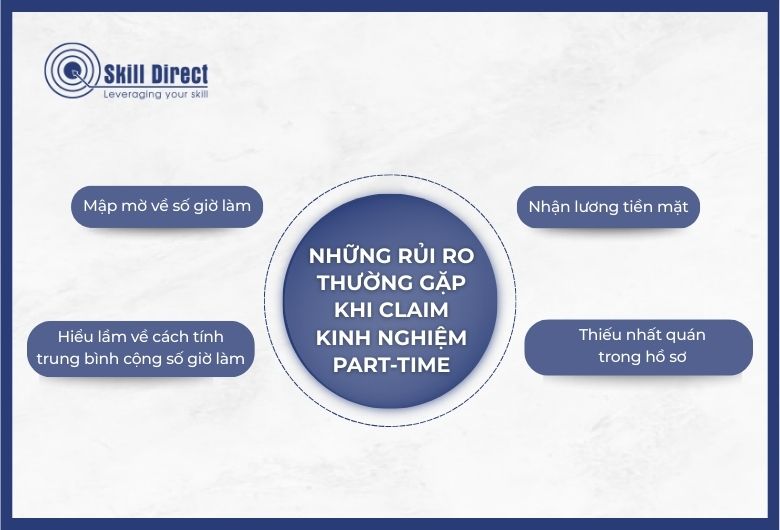
When applying for skills assessment using part-time work experience, many applicants make avoidable mistakes that can lead to refusal:
- Unclear working hours: This is one of the most common issues. The risk often arises when the reference letter does not clearly state the number of hours worked per week. Assessing authorities need an exact figure to determine whether the employment meets the minimum threshold.
- Misunderstanding how average working hours are calculated: Many applicants assume that if they work 10 hours in one week and 30 hours the next week, the average of 20 hours per week will be accepted. However, many assessing authorities, including ACS and VETASSESS, usually expect consistent employment. Weeks below the required minimum hours may be excluded from the total recognised period.
- Inconsistent documents: Another common issue is inconsistency between documents. For example, your reference letter may state that you worked 20 hours per week, but your payslips show wages that do not match 20 hours multiplied by the minimum hourly rate. This can cause the assessing authority to question the credibility of your application and may lead to refusal.
- Being paid in cash: Cash payments are common in some part-time jobs. However, this can create serious issues if there is no tax record or bank statement to support the employment. Without clear evidence, your work experience may carry little or no value for skills assessment purposes.
Part-time employment can potentially be used for a Skills Assessment, provided it satisfies the requirements of the relevant assessing authority. This may include minimum working hours, paid employment, duties relevant to the nominated occupation and sufficient supporting evidence.
The key is to check the rules that apply specifically to your occupation and assessing authority. The same part-time employment history may be treated differently by ACS, VETASSESS, TRA, Engineers Australia or another assessing authority.
If you are unsure whether your part-time work experience can be recognised for Skills Assessment purposes, the Skill Direct team can review your circumstances before you lodge your application.


