




Obtaining Australian permanent residency (PR) remains one of the most attractive migration goals for people seeking greater career opportunities, long-term stability and a better quality of life. However, Australia's migration policies continue to evolve each year, making it increasingly important to stay informed about the latest requirements and policy changes. Throughout 2026, the Australian Government has introduced a number of updates across the skilled migration program, making the pathway to permanent residency more selective while placing greater emphasis on attracting highly skilled workers who can contribute to Australia's long-term economic growth.
To help you stay ahead of these changes, Skill Direct has prepared this guide covering the Australian migration landscape in 2026 and the latest policy updates that may affect your permanent residency plans.
1. Why Do So Many Vietnamese People Aspire to Become Permanent Residents of Australia?
Australia consistently ranks among the world's most liveable countries, making it an attractive destination for migrants from around the globe, including Vietnam. Beyond its high standard of living and stable political environment, Australia offers strong economic opportunities, an excellent healthcare system and internationally recognised education. For many Vietnamese families, three key factors make Australian permanent residency an investment worth pursuing.
Build a Better Future Through Higher Income and Economic Stability
Working in Australia is not only about earning a salary—it is an opportunity to build long-term financial security and advance your career. According to the The Fair Work Commission, Australia's National Minimum Wage increased to AUD 26.44 per hour from July 2026, representing a 3.5% increase over the previous rate. For skilled migrants, Australia offers several financial advantages:
- Significantly higher earning potential: Depending on the occupation and level of experience, salaries in Australia can be substantially higher than equivalent positions in Vietnam.
- Strong demand for skilled professionals: Occupations experiencing workforce shortages including healthcare, engineering and information technology, often offer competitive salaries, with many professional positions commencing from approximately AUD 70,000–100,000 per year.
- Long-term financial stability: Australia's stable economy and relatively strong currency enable many migrants to build savings after meeting living expenses, support family members overseas and work towards major financial goals such as purchasing a home.

Access to Medicare and a World-Class Education System
Becoming an Australian permanent resident also provides access to a range of government-supported services for both you and your family:
- Medicare: Eligible permanent residents can enrol in Medicare, Australia's public healthcare system, which provides access to subsidised medical services and prescription medicines. This can significantly reduce healthcare costs over the long term.
- Quality Education: Children of Australian permanent residents generally have access to government schools under the same enrolment arrangements as other eligible residents in their state or territory. Australia is also home to many internationally recognised universities, including members of the Group of Eight (Go8), providing excellent educational opportunities for future generations.
2. Who Is Best Suited for Australian Skilled Migration?
Before deciding which visa pathway to pursue, it is important to assess whether your profile aligns with Australia's skilled migration priorities in 2026. Australia's migration program is increasingly focused on attracting applicants who possess skills that are in demand and can contribute to the country's long-term workforce needs.
The following groups are generally well positioned to pursue Australian skilled migration:
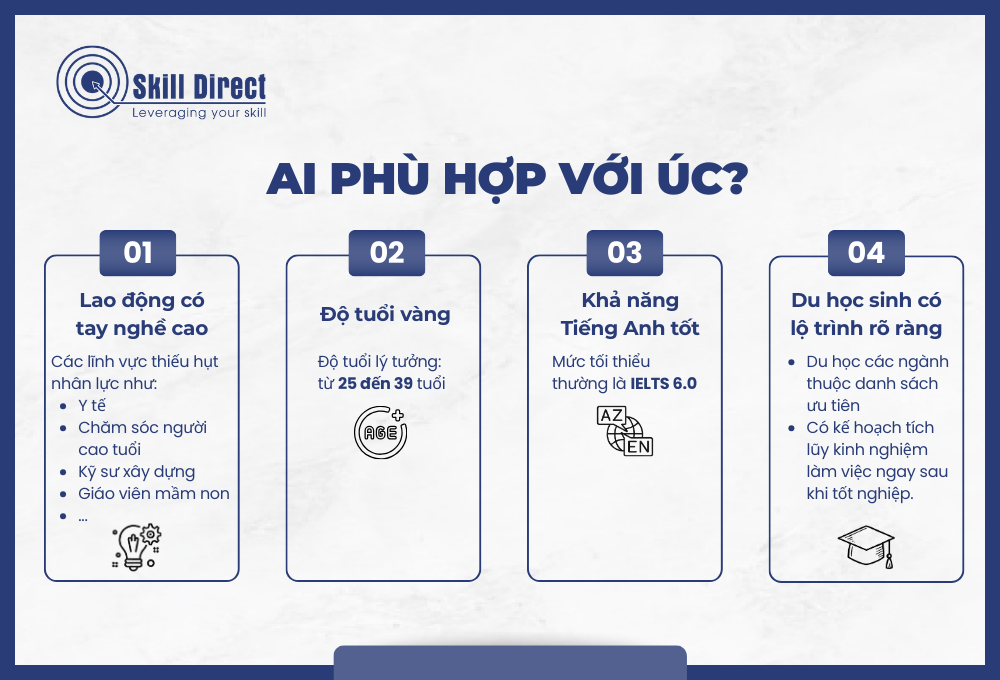
- Highly Skilled Professionals: Applicants with qualifications and work experience in occupations experiencing skills shortages are typically more competitive. These occupations commonly include fields such as: Healthcare, Aged care, Engineering, Early childhood education, Information technology.
- Applicants in Their Prime Working Age: Age continues to play an important role under Australia's Points Test. Applicants aged 25 to 32This age range is particularly advantageous, as it attracts a higher number of points under the skilled migration points test. After the age of 45, skilled migration pathways generally become significantly more limited.
- Applicants with Strong English Proficiency: English language ability remains one of the most important factors affecting migration outcomes. Although many visa pathways require applicants to demonstrate at least Competent English, achieving a higher English test score may increase your migration points and improve your competitiveness for invitation-based skilled visas.
- International Students with a Well-Planned Migration Pathway: International graduates who study occupations aligned with Australia's workforce needs and gain relevant Australian work experience after graduation are often well positioned to transition towards permanent residency through skilled migration pathways.
Important: If you currently have limited work experience or do not yet meet the required English language standard, pursuing Australian permanent residency may be more challenging. Investing in your professional skills, qualifications and English proficiency before lodging a migration application can significantly improve your long-term prospects.
3. The Most Common Permanent Residency Pathways in Australia
Australia's migration system includes more than 100 visa subclasses. However, for most Vietnamese applicants seeking Australian permanent residency (PR), there are two primary pathways to consider:
3.1 Skilled Migration
Skilled migration remains the most popular pathway to permanent residency for qualified professionals. Most skilled visas operate under (Points Test).
- Skilled Independent Visa (subclass 189):
- The Skilled Independent visa (subclass 189) allows successful applicants to live and work anywhere in Australia without requiring sponsorship from a state, territory or employer.
- General eligibility: Applicants must nominate an eligible occupation on the Medium and Long-term Strategic Skills List (MLTSSL) or another applicable occupation list; obtain a positive Skills Assessment; satisfy the Points Test; and receive an invitation from the Australian Government before lodging a visa application. As invitation rounds have become increasingly competitive, applicants often require a high points score to receive an invitation, particularly in high-demand occupations.
- Skilled Nominated Visa (subclass 190):
- The Skilled Nominated visa (subclass 190) is a permanent residence visa for skilled workers nominated by an Australian state or territory government. You commit to living in a specific state (such as NSW, VIC, QLD) for two years in exchange for receiving 5 immigration points and an invitation letter from that state.
- For many skilled migrants, the subclass 190 visa represents a more realistic pathway to permanent residency than the subclass 189 visa because state nomination can improve the overall competitiveness of an application.
- Skilled Work Regional (Provisional) Visa (subclass 491):
- The Skilled Work Regional (Provisional) visa (subclass 491) is a five-year provisional visa designed for skilled workers who are nominated by a state or territory government or sponsored by an eligible family member living in designated regional Australia. For regional areas (outside Sydney, Melbourne, and Brisbane), you will receive 15 immigration points.
- After meeting the relevant residency and income requirements, eligible subclass 491 visa holders may become eligible to apply for the Permanent Residence (Skilled Regional) visa (subclass 191).
3.2 Study, Graduate and Transition to Permanent Residency
For many young applicants, studying in Australia provides a structured pathway towards permanent residency. Rather than applying directly for skilled migration from overseas, international students have the opportunity to develop their qualifications, improve their English language skills and gain Australian work experience before applying for skilled migration. A typical pathway may include the following stages:
Study in Australia (Student Visa - Subclass 500): The journey begins by undertaking an eligible course in Australia, particularly in occupations experiencing workforce shortages, such as: Healthcare, Engineering, Construction, Information Technology, Early Childhood Education,... Choosing a qualification that aligns with Australia's workforce needs may improve future employment opportunities and strengthen a skilled migration application.
Gain Skilled Work Experience (Temporary Graduate Visa - Subclass 485): This is an important stepping stone. The Temporary Graduate visa (subclass 485) allows eligible international graduates to remain in Australia and work after completing their studies, with the visa period depending on the relevant stream and the applicant’s circumstances. This provides valuable time to gain Australian work experience and prepare for the next stage of your migration pathway.
-
-
-
Earn income to cover the cost of studying abroad.
-
Gain practical work experience to maximize your immigration points for your future Australian settlement plans.
-
-
Transition to Permanent Residency: Once the relevant visa requirements have been met, graduates may become eligible to apply for permanent residency through pathways such as: Skilled Independent visa (subclass 189); Skilled Nominated visa (subclass 190); or Skilled Work Regional (Provisional) visa (subclass 491), followed by Permanent Residence (Skilled Regional) visa (subclass 191) where eligible.

To increase their chances of Permanent Residency through this pathway, many Vietnamese students now choose to study in regional areas to gain extra immigration points and receive priority for visa renewal (485 visa) rather than competing in major cities like Sydney or Melbourne.
4. Key Australian Migration Policy Updates to Consider in 2026
Australia's migration program continues to evolve in response to labour market demands and economic priorities. Whether you are planning to apply from overseas or are already living in Australia, understanding the latest policy direction is essential for building a successful migration strategy. Based on our experience assisting skilled migration applicants, Skill Direct highlights the following key considerations.
Greater Focus on Employer-Sponsored Migration
The Employer Sponsored allocation has seen the largest increase, rising from 44,000 to 58,040 places. If you are currently working in Australia or have an opportunity to secure sponsorship from an Australian employer, employer-sponsored pathways are receiving greater emphasis under the 2026–27 Migration Program.
Student Visa Requirements Have Become More Rigorous
If you are planning to pursue a study-and-settlement path, pay particular attention to the GS (Genuine Student) test. Instead of the old GTE essay, Australia uses the GS test with more practical questions to weed out applications that use studying as a pretext for work. Applications with illogical study plans have a very high rejection rate.
Therefore, in the context of constantly changing Australian immigration laws, early preparation and a clear strategy are key to seizing opportunities for permanent residency. If you want to have your profile assessed and build a roadmap tailored to your goals, contact Skill Direct today for detailed advice from our team of experienced experts!


