




Subclass 491 - Skilled Work Regional (Provisional) visa is increasingly becoming a valuable pathway for skilled workers seeking to build their future in Australia. As Subclass 189 and Subclass 190 visas become increasingly competitive in terms of points and migration allocations, the Subclass 491 visa opens up greater opportunities for those living in regional Australia.
However, with 8 states and territories, each having its own Occupation List and eligibility criteria, navigating all the available information on your own can be challenging. Which state should you choose to increase your chances of securing a visa? Is your occupation currently being prioritised? Let Skill Direct help you understand the strategy for pursuing a Subclass 491 visa in a structured and well-planned way.

1. Challenges of the Subclass 491 Visa
The Subclass 491 visa provides significant opportunities to settle in regional Australia, but it is also a visa pathway that is highly dependent on individual state and territory governments. A small mistake in understanding the requirements of a particular state could cost you a valuable opportunity to receive an invitation.
Below are the key points you need to understand before starting this pathway.
1.1 Each State Has Its Own Policy
The biggest challenge with the Subclass 491 visa is the lack of uniformity. There is no single formula that applies across Australia. You are dealing with 8 separate assessment systems across Australia’s 8 states and territories.
- Occupation List requirements: The first requirement is that your occupation must be included on the relevant state or territory’s priority occupation list. An occupation may be in high demand in South Australia (SA) but may not be required in Victoria.
- Complex invitation mechanisms: Even after meeting the basic eligibility requirements, you still need to pass additional screening mechanisms such as a Registration of Interest (ROI) or the Canberra Matrix. Applying the same nomination strategy from one state to another will almost certainly lead to failure. Below are four groups based on their invitation mechanisms.
Group 1: States that receive information through EOI and issue invitations to suitable candidates
- States: New South Wales (NSW), Western Australia (WA), SA (offshore).
- Challenge: Competition is extremely high. You cannot proactively apply for nomination and are entirely dependent on the state’s selection process. If the state considers your profile suitable, it will invite you to apply for nomination.
Group 2: States that require a Registration of Interest (ROI)
- States: Victoria (VIC), Queensland (QLD), Tasmania (TAS), South Australia (SA) (onshore).
- Process: After submitting your EOI, you mandatory must submit a separate Registration of Interest through the relevant state system, known as an ROI. Without an ROI, the state will not consider your application.
- Challenge:
- Selection: These states require you to choose one of the two subclasses, either 190 or 491, when submitting your ROI. Choosing the wrong strategy could mean losing your opportunity for that entire financial year.
- Commitment requirements: These states often require evidence of your earning capacity and commitment to living and working in the state long-term. For example, Tasmania uses a Priority Attributes system to classify applicants and prioritise candidates who can make a long-term contribution to the state.
Group 3: Separate points-based system
- States: Australian Capital Territory (ACT – Canberra)
- Process: In addition to the general migration Points Test, the ACT applies its own Canberra Matrixsystem. The higher your Matrix score, the greater your chances of receiving an invitation.
- Challenge: The points system is complex, and you need to understand the ACT’s specific requirements. The ACT also requires you to clearly choose whether you are applying for Subclass 190 or Subclass 491 from the outset.
Group 4: Direct nomination application
- States: Northern Territory (NT).
- Process: The NT is one of the few jurisdictions that allows you to lodge a state nomination application directly if you meet the eligibility requirements, without having to wait passively for an invitation.
- Challenge: The number of nominations and annual allocations is limited, and places can fill quickly. The application portal opens at a particular time and closes once the available places have been filled.
Note: The current general trend is for states to prioritise applicants already living in the state. Applicants who are currently living and working onshore in the relevant state generally have a significant advantage over interstate or offshore applicants.
These are the key general differences between states and territories in assessing Subclass 491 applicants that you should understand before moving on to the next steps.

1.2 Too Many Streams to Choose From
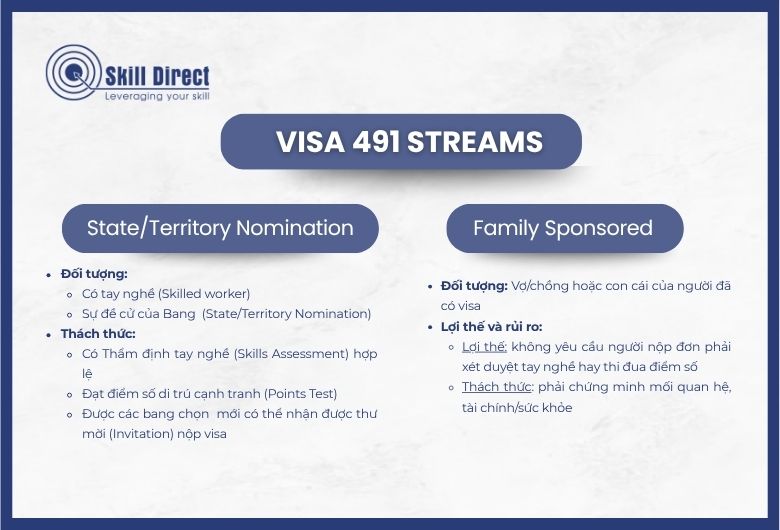
The Subclass 491 visa is currently divided into two streams with completely different requirements and pathways:
State/Territory Nomination: This stream is for applicants seeking state or territory nomination who have the required experience, professional skills and educational qualifications.
- Eligible applicants: Skilled workers seeking a migration pathway through State Nomination.
- Challenge: You are under significant pressure throughout this process. You must have a valid Skills Assessment, achieve the highest possible migration Points Test score and, most importantly, be selected by a state or territory before you can receive an invitation to apply for the visa.
Family Sponsored: This stream is for family members seeking to reunite with someone who already holds a Subclass 491 visa in Australia.
- Eligible applicants: The spouse/partner or children of an existing visa holder.
- Benefits and risks: This stream does not require applicants to undergo a Skills Assessment or compete based on migration points. However, the challenge lies in demonstrating the relationship and meeting financial/health requirements. If the supporting evidence is not sufficiently strong, your family member’s visa may be refused or processing may be prolonged for years.
In summary, whether you apply through the State/Territory Nomination or Family Sponsored , every Subclass 491 visa application requires careful preparation and compliance with the relevant legal requirements to avoid wasting time and money.
2. Skill Direct’s Personalised Subclass 491 Visa Pathway
At Skill Direct, we provide personalised strategic advice for each client applying for a Subclass 491 visa. A successful pathway requires a combination of three factors: Choosing the right state – Optimising your points – Obtaining a Skills Assessment.
State selection strategy for the Subclass 491 visa
Not every state that offers an easier migration pathway will necessarily be suitable for you. Skill Direct will analyse your circumstances based on:
-
Occupation priority: Each state has its own workforce objectives and skills shortage lists. An ANZSCO occupation may be in significant demand in one regional area but already saturated in another. We help you research and cross-check data across all 8 states and territories to identify where your skills are most in demand.
-
Personalised profile assessment: Whether you are a recent international graduate, an experienced worker or a business owner, each applicant group has different advantages when approaching individual states. Skill Direct will comprehensively assess your profile and guide you towards states whose policies are most compatible with your current circumstances, helping maximise your chances of receiving an invitation instead of applying indiscriminately.
Points optimisation strategy
The Subclass 491 visa provides 15 points through state nomination. However, this may still not be enough if you do not effectively optimise your individual Points Test score. Understanding this, Skill Direct provides strategic advice to help you comprehensively optimise your points based on your specific circumstances.
Every applicant has different strengths. Therefore, Skill Direct develops a personalised strategy based on each applicant’s actual circumstances, with the aim of maximising their points while minimising the risk of the Department of Home Affairs adjusting or deducting points after the application has been lodged.
Optimising your points correctly from the outset is a key factor in determining your chances of receiving a Subclass 491 visa invitation.
Preparing your Skills Assessment
This is an important step and also a prerequisite for your Australian migration pathway. You cannot submit an EOI and proceed towards receiving a Subclass 491 visa invitation without a valid Skills Assessment.
Each occupation is assessed by a specific assessing authority, such as ACS (IT occupations), VETASSESS (general occupations), Engineers Australia (engineering occupations), and TRA (trade occupations). Each assessing authority has different assessment criteria and requirements, particularly strict requirements regarding evidence of employment experience.
In practice, many applicants receive negative Skills Assessment outcomes because they select the wrong occupation code (ANZSCO) or their Job Description does not appropriately align with the nominated occupation. Skill Direct helps you eliminate these risks from the outset and prepare your application in the right direction to maximise your chances of receiving a positive Skills Assessment outcome.
With experience handling many complex applications, Skill Direct assists in preparing and explaining your entire employment evidence, including Reference Letters, payslips, tax documents and employment contracts, ensuring that the information closely aligns with the requirements of the relevant assessing authority
3. Benefits of Choosing Skill Direct as Your Migration Partner
In a migration market where reliable and unreliable information can be difficult to distinguish, Skill Direct positions itself as a professional and responsible. migration consultancy. We do not sell unrealistic promises; we provide practical solutions.

Comprehensive support
Your journey with Skill Direct does not end when you receive your Subclass 491 visa.
- Preparation stage: Profile assessment, career pathway guidance and Skills Assessment preparation.
- Application stage: Lodgement of EOI, ROI, Nomination and Visa Application with absolute accuracy.
- Waiting stage: Continuous updates on the latest migration law changes so your application can be adjusted promptly, including updating your EOI.
- Post-visa stage: The Subclass 491 visa is a 5-year provisional visa that requires you to live and work in a regional area for 3 years before progressing to permanent residence through the Subclass 191 visa. Skill Direct will continue to support you and guide you in complying with your visa conditions to help ensure the smoothest possible pathway to PR (Permanent Residence).
Complete transparency in our advice
- No hidden costs: All costs, including service fees, government fees, health examination fees and translation fees, are clearly listed in the service agreement when you engage us for your Subclass 491 visa application.
- Genuine assessment: If your profile is weak or your prospects of success are low, we will tell you directly and propose ways to improve your profile, such as completing an additional qualification or improving your English, rather than simply accepting your application and processing it mechanically.
Our formula for success: Experience + Knowledge + Flexibility
The team of Skill Direct has an in-depth understanding of Australian Migration Law. We work based on the relevant legislation. The combination of our experience handling hundreds of applications and our continuous monitoring of changes from the Department of Home Affairs enables us to develop the most suitable pathway for each client.
The Subclass 491 visa opens up countless opportunities for you in Australia, so do not let a lack of understanding cause you to miss your opportunity to build a future in this beautiful country.


