




The Subclass 189 visa is one of the most sought-after pathways to Australian permanent residence, offering skilled migrants the opportunity to settle in Australia without state or territory nomination or employer sponsorship, together with greater flexibility over where they live and work.
However, as places under Australia’s skilled migration program remain limited and competition through SkillSelect continues to be strong, securing an invitation for a Subclass 189 visa is becoming increasingly challenging. With thousands of Expressions of Interest (EOIs) competing in the system, how can you strengthen your profile and improve your prospects of receiving an invitation?
This article examines the competitive nature of the Subclass 189 visa and explains how professional migration support from Skill Direct can help you develop a more informed and strategic pathway towards Australian permanent residence.

1. Why Is the Subclass 189 Visa So Attractive Yet Difficult to Obtain?
Subclass 189 (Skilled Independent Visa) is a permanent visa for eligible skilled workers who meet the requirements of Australia’s points-tested skilled migration program. Unlike pathways such as the Subclass 190 or employer-sponsored visas, the Subclass 189 does not require nomination by an Australian state or territory government or sponsorship by an employer.
This independence is one of the main reasons the visa is so attractive. At the same time, the limited number of invitations and strong competition among skilled applicants can make the pathway particularly challenging.
1.1 Key Benefits of the Subclass 189 Visa
The Subclass 189 visa offers significant benefits as an Australian permanent residence pathway.
Become an PR upon visa grant
Unlike provisional regional pathways such as the Subclass 491 visa, the Subclass 189 is a permanent visa. Once granted, you become an Australian permanent resident.
Freedom to live and work across Australia
One of the major advantages of the Subclass 189 visa is the flexibility it provides in choosing where to live and work.
- Subclass 190: Applicants are nominated by a state or territory and are generally expected to honour the commitments associated with that nomination.
- Subclass 491: Visa holders are subject to regional conditions and must meet the relevant requirements before they can transition to permanent residence through the Subclass 191 pathway.
- Subclass 189:: There is no state or territory nomination requirement and no employer sponsorship obligation. This provides greater flexibility to live and work across Australia and to change employers as your career develops.

Access to Medicare and education
As an Australian permanent resident, a Subclass 189 visa holder can enrol in Medicare, subject to the applicable eligibility requirements. Permanent residents and their families may also have access to public education arrangements. School fees and eligibility requirements can vary between Australian states and territories, so the applicable rules should be checked based on where the family lives.
Sponsor eligible family members and pursue Australian citizenship
Once you hold a Subclass 189 visa, you can sponsor your spouse/partner and children to come to Australia. After meeting the applicable residence and other eligibility requirements, your family may be able to apply for Australian citizenship and become Australian citizens.
The Subclass 189 visa is attractive because it offers security, freedom and access to significant benefits. However, you need to understand a simple principle: the more valuable something is, the more difficult it can be to obtain.. This is why this visa requires applicants to prepare their profiles strategically.
1.2 Securing a Subclass 189 Invitation Is Highly Competitive
Although the Department of Home Affairs sets the minimum Points Test at 65 points, the reality is that competition can be significantly more intense. This minimum threshold is often only an eligibility requirement and may not be sufficient to secure an invitation in current invitation rounds.
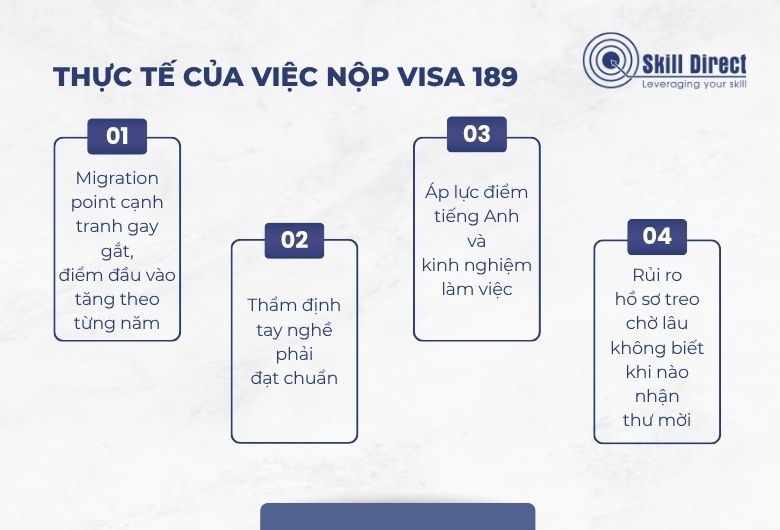
Highly competitive migration points, with invitation scores increasing over time
Australia’s SkillSelect system operates on a ranking basis: applicants with higher points are generally invited ahead of those with lower points. The minimum threshold of 65 points is only the basic requirement to submit an Expression of Interest (EOI). However, in recent invitation rounds, invited applicants have often had scores of 90, 95, or even 100 points for highly competitive occupations.
In addition, you are not only competing with Vietnamese applicants but also with skilled candidates from India, China, the United Kingdom, the Philippines and other countries. These candidates may have advantages in English proficiency and extensive work experience.
As more applicants seek to maximise their points, such as by obtaining NAATI credentials or achieving PTE scores of 79+, the overall points benchmark continues to rise, leaving profiles with 70–80 points with very limited prospects for a Subclass 189 visa.
Skills Assessment must meet the required standards
Before considering submitting an EOI, you must first obtain a suitable Skills Assessment. This is a step that many applicants delay, potentially causing them to miss opportunities to apply for a visa. Each occupation has its own assessing authority, such as ACS for IT professionals and Engineers Australia (EA) for engineers. Each assessing authority has strict requirements regarding job descriptions, qualifications, work experience and evidence of income. If even a few aspects of your application do not align with the assessing authority’s requirements, you may receive a negative outcome.
Pressure to achieve high English scores and demonstrate work experience
To compete for a Subclass 189 visa, Competent English is not enough. You need to aim for Superior English to obtain the maximum 20 migration points for English proficiency. In addition, demonstrating work experience for points purposes can involve significant risks. The Department of Home Affairs carefully examines tax records, social insurance records and bank statements. If you provide false or inflated information to make your profile appear stronger, you may not only have your visa refused but could also face the risk of being permanently banned from entering Australia.
Risk of waiting for a long time without knowing when an invitation will arrive
A difficult reality is that an EOI remains valid for 2 years, but there is no guarantee that you will receive an invitation during that period.
Each financial year, the Australian Government allocates a limited quota for the Subclass 189 visa. Once the allocated quota has been reached, even applicants with high points may have to wait until the following year.
Australia prioritises nurses, teachers, trades and healthcare occupations. If your occupation is not within an area of critical priority, your profile may remain in the system for a long time, potentially resulting in you becoming too old to claim certain age points or your English test results expiring.
2. Why Choose Skill Direct for Your Subclass 189 Visa?
The complexity of Australian migration policies, combined with increasingly intense competition among applicants, can make preparing and lodging an application yourself more challenging than you might expect. Without clear direction, you may struggle to determine the right approach and could even miss the ideal time to lodge your application.
For this reason, Skill Direct is not simply a migration consultancy but also a strategic partner that supports you in maximising every possible point to help turn your Australian migration goals into reality.
In-depth understanding of migration law and SkillSelect trends
The team of professionals at Skill Direct continuously monitors the latest changes from the Department of Home Affairs. We understand which occupations are currently prioritised and which states are experiencing workforce shortages, allowing us to prepare alternative options beyond the Subclass 189 visa. Instead of submitting an application without a clear strategy, we help you identify a pathway that is appropriate for your nominated occupation.

Specialists in Skills Assessment applications
Skill Direct is proud to have an almost perfect success rate for Skills Assessment applications. We know exactly what each assessing authority, such as ACS, VETASSESS and TRA, expects to see in your application.
Transparent advice
At Skill Direct, we do not paint unrealistic pictures that prevent clients from properly understanding the strengths and limitations of their own profiles. We assess applications based on actual information and provide personalised advice. If the Subclass 189 visa presents too much risk for your profile, we will openly advise you on alternative pathways, such as the Subclass 190, Subclass 491 or further study and course transition options, to help keep your Australian migration goals on track.
3. Skill Direct’s Service Process
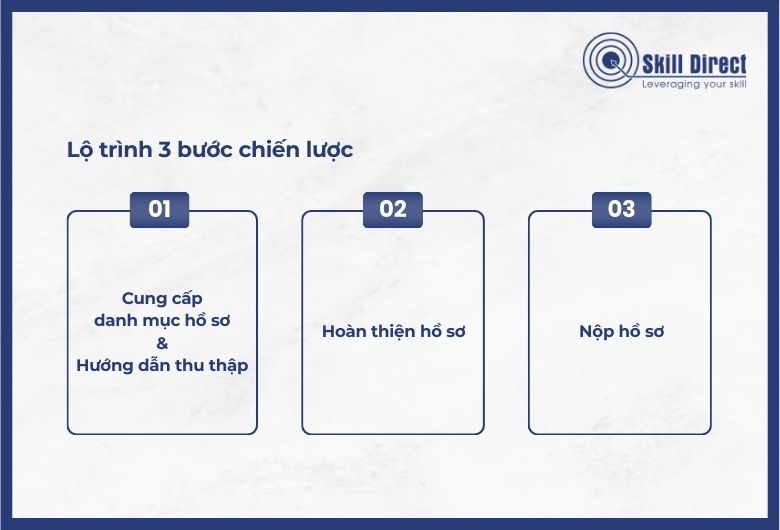
At Skill Direct, we have standardised our services into a strategic three-step process. The key difference lies not in the administrative procedures themselves, but in our absolute dedication and commitment:
- Document Checklist & Guidance on Collecting Documents
Based on your specific visa subclass and tailored migration pathway, Skill Direct provides a comprehensive and customized document checklist to ensure a seamless preparation process.
- Personalised guidance: We provide detailed guidance on how to prepare identity documents, qualifications, and evidence relating to finances or relationships, where applicable.
- Template support: We provide standard document templates in line with Australian immigration requirements to help ensure the validity of your documents from the beginning.
- Application Preparation (Drafting & Review)
Our expert team directly manages and refines all critical documentation to strategically maximize your application’s success rate.
- Information review: We carefully cross-check information across your CV, reference letters, and visa application forms to ensure consistency.
- Sending documents to clients for confirmation: You will have the opportunity to review the full visa application forms and confirm the accuracy of the information before official lodgement.
- Support with additional documents: We advise on and draft explanation letters or supporting documents based on the specific circumstances of your application.
- Lodging the Application (Submit Application)
Skill Direct acts on your behalf to complete the legal procedures with the Department of Home Affairs.
- Official lodgement: We lodge the application through the relevant system and closely monitor its progress.
- Responding to Department requests: Directly handling and responding to requests from the Department of Home Affairs for additional information, health examinations or police checks.
- Status updates: Timely notification of all case developments through to the final visa result.
Subclass 189 represents the pinnacle of the Australian migration dream, but the pathway to achieving it is far from easy. It requires persistence, capability and a smart strategy. Therefore, do not let minor mistakes in your documents or a lack of understanding of Australian migration law cause you to miss an opportunity that could change your life.


