




To complete your documentation for an Australian Skills Assessment, you typically need your former employers to formally verify your employment history and daily duties. However, a highly challenging scenario can occur: your former company has gone bankrupt and no longer exists in the market.
How do you prove your professional background under these circumstances? Do you have to abandon your dream of migrating to Australia simply because you cannot complete your Skills Assessment? In this article, Skill Direct will provide clear solutions to navigate this critical hurdle.
1. Understanding the Australian Skills Assessment
ASkills Assessmentis a mandatory and foundational checkpoint in your skilled migration pathway to Australia. However, gathering the required evidence, addressing gaps, and processing the application takes a substantial amount of time. Even after submission, a positive outcome is never guaranteed. Consequently, many applicants miss out on state nomination windows simply because they failed to secure their positive Skills Assessment in time.
1.1 Why You Must Initiate Your Skills Assessment Early ?
Proactively finalizing your Skills Assessment early grants you a significant competitive edge, allowing you to react immediately when state allocation quotas open. For a comprehensive breakdown of these strategic advantages, you can read our dedicated article: “Why You Should Complete Your Skills Assessment as Early as Possible” (Link to be added post-publication).
1.2 How important is empirical evidence?
In a skilled migration application, your work experience is not evaluated merely by the number of years on your CV, but by the exact alignment of your day-to-day duties with your nominated ANZSCO code. Assessing authorities base their decisions entirely on the objective documentation you provide; therefore, your evidence must be clear, consistent, and highly verifiable.

The more comprehensive your secondary evidence, the lower your risk of receiving a time-consuming Request for Further Information (RFI), facing processing delays, or receiving a negative outcome. Many applicants face setbacks not due to a lack of professional capability, but due to a lack of compliant, verifiable paperwork.
2. Navigating a Skills Assessment When a Former Company Has Gone Bankrupt
You return to your former workplace to request employment references, only to find the business has folded. How do you claim this work experience in your Skills Assessment application?
2.1 Core Challenges of a Defunct Employer
Securing compliant employment references is complex under normal circumstances, but the difficulty escalates exponentially when the enterprise no longer exists. Key challenges include:
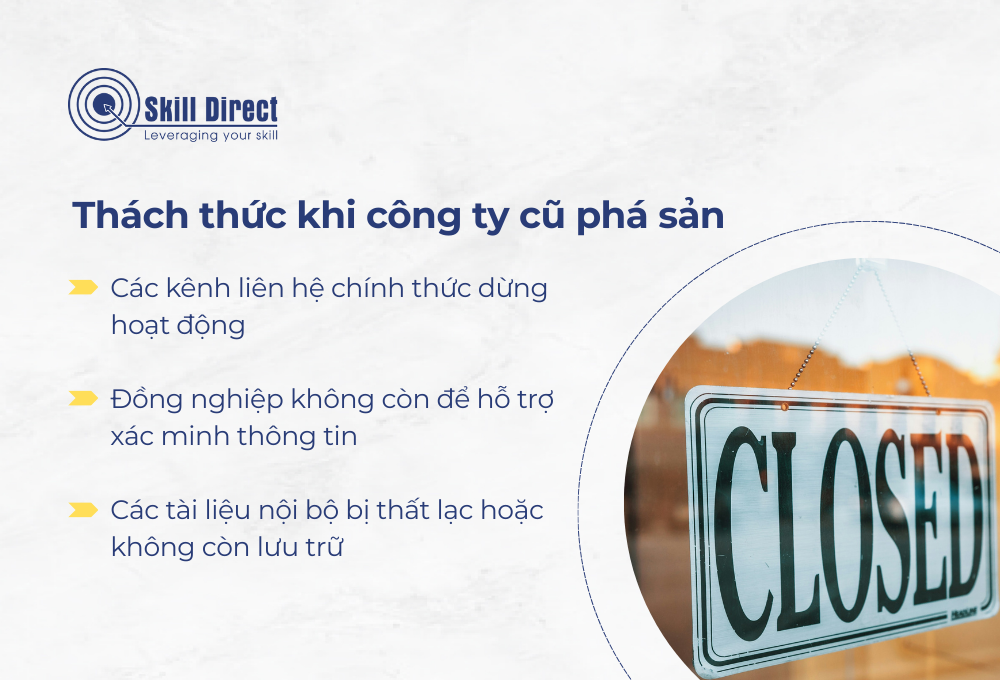
The first, official communication channels—such as company email domains, corporate phone lines, and HR portals—shut down post-liquidation. This prevents you from obtaining a standard Employment Reference Letter on official company letterhead.
The second, former HR managers and direct supervisors who could have verified your tenure and daily tasks have dispersed to different companies. Tracking them down to sign declarations can be incredibly difficult, especially if contact details are outdated.
The third, primary documents like original employment contracts, monthly payslips, official tax filings, clear job descriptions, or internal HR files may have been misplaced or deleted when the business closed. This deprives you of primary evidence, heavily increasing the risk of an application rejection.
These challenges demonstrate that proving experience becomes significantly more complex when a previous employer has gone bankrupt. Therefore, you need to proactively prepare a strategy for gathering alternative evidence as early as possible to minimize risks when submitting your Skills Assessment application.
2.2 Conditions for experience to still be recognized
To transform this administrative obstacle into a successful application and maximize your chances of a positive outcome, you must systematically execute the following steps:
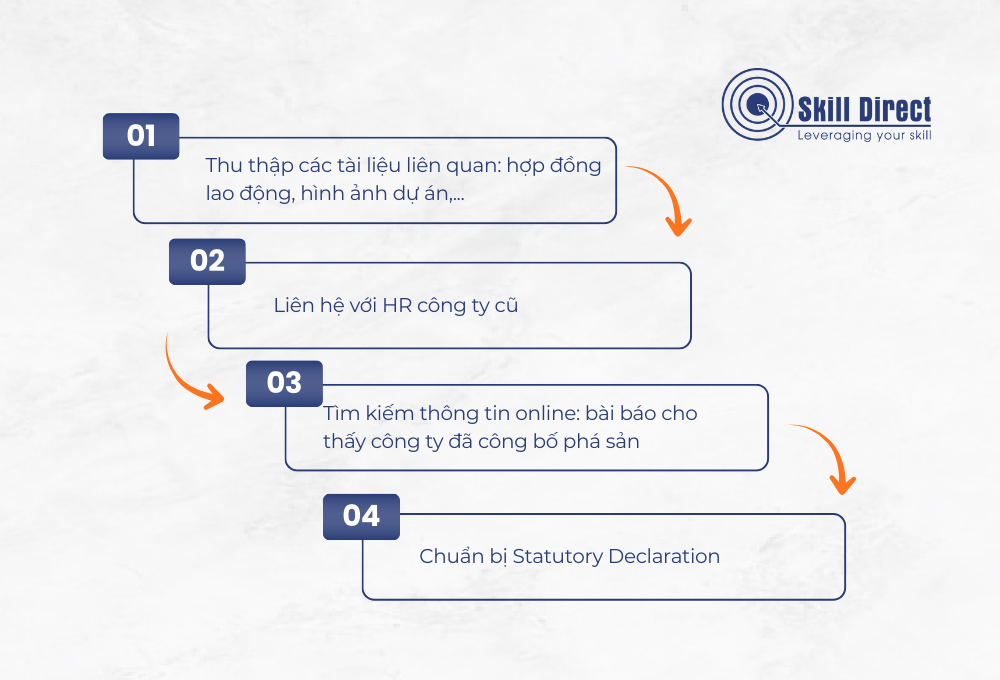
Step 1: Gather relevant documents
If you still have your employment contract (whether the original or a copy), it can serve as a key piece of evidence to establish your employment period and position held. In addition, you should collect any work-related documents that may support your claim, such as proposals, project reports, designs, product prototypes, email correspondence, acceptance records, and other relevant materials.
These documents can help demonstrate the duties you performed, the responsibilities you undertook, and the outcomes of your work. Skill Direct believes that, in today's digital working environment, many important files are likely to have been stored on cloud platforms or personal devices. Therefore, make sure you thoroughly review all of your available storage sources.
Step 2: Contact the HR Department of Your Former Employer
If you are still in contact with your former HR personnel or manager, you may ask them to provide an employment reference letter confirming your position, period of employment, and job duties. A reference letter issued by the HR department generally carries a high level of credibility during the skills assessment process, as HR personnel are responsible for maintaining employment and recruitment records.
Step 3: Search for Publicly Available Information
You may also search for news articles, forum discussions, or other publicly available information demonstrating that the company has ceased operations or entered liquidation. Such evidence can help explain why you are unable to provide complete internal documentation and provide context regarding the company's operational status before its closure.
For companies in Vietnam, businesses legally registered with the authorities generally have their operating status publicly available through the national tax registration system. You may therefore obtain evidence of the company's closure or dissolution from the relevant government website.
Step 4: Prepare a Statutory Declaration
Once you have gathered all available alternative evidence, you should prepare a detailed Statutory Declaration that clearly outlines the sequence of events, describes the work you performed, and explains why certain internal documents are no longer available. The declaration should be properly witnessed and certified in accordance with the applicable legal requirements. This document can assist the assessing authority in understanding the circumstances of your case when reviewing your application.
3. How to Minimise Risks and Strengthen Your Application
Preparing your own application can save you initial costs, but it also carries risks if you don't understand the procedures and requirements of each skills assessment agency. When gathering and organizing documents yourself, it can be difficult to determine if your application meets all the criteria. Missing a document or incorrect formatting can delay your application, require additional documents, or even lead to rejection.
In addition, complex situations such as a former employer becoming insolvent, business restructuring, or the departure of your direct supervisor can make it more challenging to substantiate your employment history. These are common issues faced by applicants who prepare their own applications, often leading to unnecessary delays or missed migration opportunities.
Such risks may cause you to miss the opportunity to lodge your skills assessment during the 2025–26 financial year, directly affecting your ability to submit an Expression of Interest (EOI) on time and be ready when state and territory governments open their invitation rounds. More importantly, if you are unable to proceed this year, there is no guarantee that your nominated occupation will remain eligible in future invitation rounds, as occupation lists and state nomination requirements can change at any time.
For this reason, engaging experienced professionals such as Skill Direct from the early stages of the process can help you develop a strategic and effective approach. Our team can assist you in assessing your eligibility, preparing compliant documentation, and addressing complex circumstances, ensuring that your skills assessment process proceeds as smoothly and efficiently as possible.


