




Have you invested considerable time, effort, and money into your ACS Skills Assessment, only to receive a devastating negative outcome? In this comprehensive guide, Skill Direct walks you through the exact steps to remedy a negative assessment, covering foundational concepts and expert operational strategies to maximize your chances of turning that decision around.
1. What is the ACS Skills Assessment?
1.1 Definition and Core
The ACS (Australian Computer Society) is the official assessing authority gazetted by the Australian Government to evaluate professional qualifications and employment histories within the Information and Communications Technology (ICT) sector.
The ACS evaluation framework is strictly mapped against several benchmark systems, including the Australian Qualifications Framework (AQF), the Higher Education Standards Framework (HESF), the Seoul Accord, and the Skills Framework for the Information Age (SFIA), alongside specialized international ICT benchmarks like the Software Engineering Body of Knowledge (SWEBOK).
The ACS assessment acts as a crucial screening mechanism for the Department of Home Affairs, verifying that international tech professionals possess skills that match Australian domestic standards. For applicants, a positive ACS outcome is the ultimate prerequisite to secure migration points and lodge an Expression of Interest (EOI) for general skilled visas.

1.2 Targeted ICT Occupational Streams
Careers in the Information Technology (ICT) field are divided into three main groups:
- Data Science Occupations
- IT Occupations
- Cyber Security Occupations
Each ecosystem contains multiple distinct ANZSCO roles, ranging from data analysts and software developers to systems administrators and cyber security specialists.
The active, eligible skilled occupation list is updated dynamically on the official Australian Computer Society (ACS), making it vital to cross-reference your specific duties with the correct code before lodgement.
1.3 The Mandatory Documentary Evidence Portfolio
To successfully lodge an ACS Skills Assessment, you must compile a robust, fully compliant portfolio containing:
- Academic Credentials and Transcripts: To verify your educational tier and the percentage of ICT-related course content.
- Primary Identity Documents: High-resolution color scans of your valid passport and national ID.
- Formal Employment Reference Letters: These must be printed on official corporate letterhead and contain exact employment periods, specific job titles, employment nature (full-time or part-time, including exact hours worked per week), salary details, a comprehensive list of core daily duties, and the referee's verified contact details (signature, name, title, official corporate email, and phone number).
- Multi-Layered Financial Evidence: Verifiable, third-party proof of income—such as historical payslips, official tax assessment notices, social security contributions, and continuous bank statements showing salary deposits.

Ensuring your evidence is perfectly structured and "decision-ready" from day one slashes your processing timeline and eliminates the risk of an unexpected Request for Further Information (RFI) or an immediate refusal. Furthermore, initiating your Skills Assessment early allows you to proactively manage any potential issues, such as submitting additional documents, lodging appeals, or adjusting your migration plan without missing out on invitation rounds.
2. The ACS Migration Assessment Pathways
To understand how ACS reviews and evaluates your application, you need to be familiar with the ACS evaluation process to determine the path that best suits your qualifications and experience.
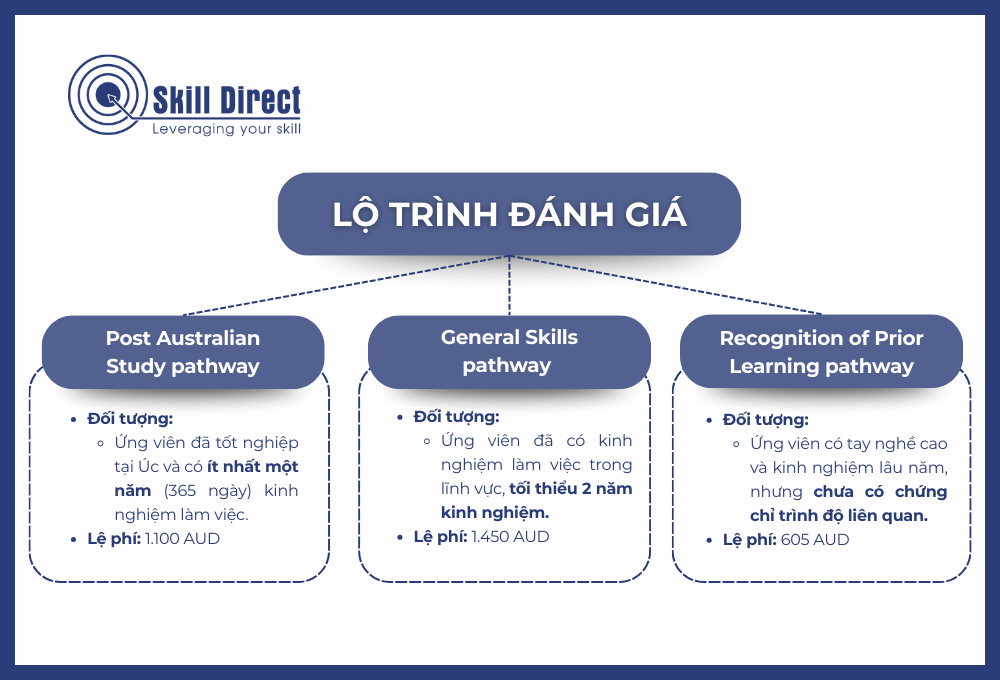
2.1 Post Australian Study Pathway
Post Australian Study Pathway is designed for international graduates who have completed an accredited ICT degree at an Australian tertiary institution and have accumulated at least one year (365 days) of post-qualification ICT employment within Australia. To qualify, applicants must have worked a minimum of 20 hours per week in a highly relevant ICT role.
Alternatively, completing an approved ACS Professional Year Program can be used to satisfy the professional employment requirement while building vital corporate acumen within the Australian tech market.
Current Application Fee: $1,100 AUD (payable at the time of online lodgement).
2.2 General Skills pathway
General Skills Pathway is the most heavily utilized route, catering to overseas applicants with extensive qualification-backed experience in Information Technology, Data Science, or Cyber Security.
Generally, applicants must prove a minimum of 2 years of relevant ICT experience within the last 10 years, or 4 years of relevant experience across their entire career history, depending on which timeline yields the earliest viable skill date under ACS calculation rules.
Current Application Fee: $1,450 AUD .
2.3 Recognition of Prior Learning (RPL) Pathway
Recognition of Prior Learning pathway tailored for highly experienced tech professionals who have forged successful careers in ICT, Data Science, or Cyber Security but lack formal, ICT-related tertiary degrees. chứng chỉ trình độ đại học liên quan.
To clear this pathway, applicants must demonstrate a minimum of 6 years of professional-grade ICT work experience. Crucially, your most recent employment must either be current or have concluded within the last 2 years at the time of application, and you must complete a detailed RPL Project Report proving your mastery across SFIA knowledge domains.
Current Application Fee: $605 AUD.
3. How to handle negative ACS application results
Receiving a negative skills assessment letter can be alarming, but it does not mean your migration goals are over. In many cases, a negative decision is simply down to an administrative error or unclear documentation. The key is to remain calm, audit the refusal reasons, and deploy the formal ACS review and appeal framework. This dispute mechanism operates across two structured levels.

3.1 Level 1 appeal
The Level 1 Appeal functions as an internal administrative review. Upon lodgement, your entire application file is assigned to an independent Senior Assessor who was completely un-involved in your initial evaluation, ensuring an unbiased audit.
Applicants have the right to appeal within 60 days of receiving a negative result. At Level 1, you can still add new evidence to clarify and strengthen your application. The ACS will then receive and review your application. Finally, the agency will respond with a result within 30 days.
The results of the Level 1 Appeal will be communicated to the applicant in writing. If the result changes from negative to positive, ACS will refund the appeal fee. However, if the application does not provide sufficient supporting evidence or the result remains unchanged, the fee will not be refunded. In that case, you may consider submitting an appeal to Level 2 for further consideration.
3.2 Level 2 appeal
The Level 2 Appeal is the final escalation tier, accessible only after a Level 1 Review has been formally finalized and upheld. This functions as a strict external review to guarantee complete transparency and operational compliance.
Applicants can submit an appeal within 30 days of receiving the Level 1 result. At this level, you are not allowed to add new evidence; the entire application will be reviewed based on the documents previously submitted.
ACS will hire independent experts with high expertise in the field to re-evaluate the application, ensuring transparency and fairness in the assessment process. Typically, the results of a Level 2 Appeal will be responded to within 60 days.
Note: The determination issued at Level 2 is absolute, legally binding, and represents the final administrative remedy within the ACS ecosystem.
4. Expert Recovery Strategies for Navigating a Negative Assessment
While a negative ACS assessment can feel like a setback, treating it as a dynamic roadmap for correction is the best way forward. According to The Registered Migration Agents at Skill Direct, the most critical step is to methodically dissect the exact phrasing of your rejection letter to isolate why your file fell short.
Begin by cross-referencing the assessor's notes against your initial submission. If your experience was discounted because your references lacked sufficient detail or your financial streams were unverified, you can build a stronger, multi-layered evidence portfolio and execute a Level 1 Appeal within the 60-day window. If the refusal is tied to deep-seated discrepancies between your day-to-day corporate responsibilities and your nominated ANZSCO code, engaging a registered migration specialist is vital to accurately realign your profile and prevent a permanent rejection.
Ultimately, a negative outcome is a hurdle, not a dead end. Skill Direct is ready to step in at any stage of your journey—delivering forensic profile reviews, restructuring your technical evidence, and designing a bulletproof recovery roadmap to successfully flip your negative decision into a positive outcome. Reach out to Skill Direct today to secure your digital career path in Australia!


