




Even if you have years of hands-on work experience but do not hold a relevant qualification, there may still be a pathway available to you. Through Recognition of Prior Learning (RPL), your practical skills and industry experience can potentially be recognised as equivalent to an Australian qualification. Let's explore why RPL is so important and how it may support your Australian migration journey.
1. What is RPL and Why Should Skilled Workers Consider It?
1.1 What is RPL?
RPL (Recognition of Prior Learning) là quy trình chuyển đổi và recognises your existing skills, knowledge, and work experience against the requirements of an Australian qualification.Through RPL, you may be able to obtain an Australian-recognised qualification without undertaking the full course of study, provided you can demonstrate that your prior learning and professional experience meet the required competency standards.
1.2 How Does RPL Support Australian Migration?
For many skilled workers, RPL can be an important first step towards Australian migration. Some of the key benefits include:
- Save time and money: Instead of enrolling in a full qualification program in Australia, you may be able to convert your existing work experience into a nationally recognised qualification under the Australian Qualifications Framework (AQF).
- Improve employment opportunities: An Australian-recognised qualification can strengthen your employability and provide greater confidence to Australian employers regarding your skills and competency.
- Support Skills Assessment and migration pathways:In some occupations, obtaining an Australian qualification through RPL may assist with meeting the qualification requirements for a Skills Assessment, which is often a mandatory step for skilled migration visas such as Subclass 189, 190, and 491.
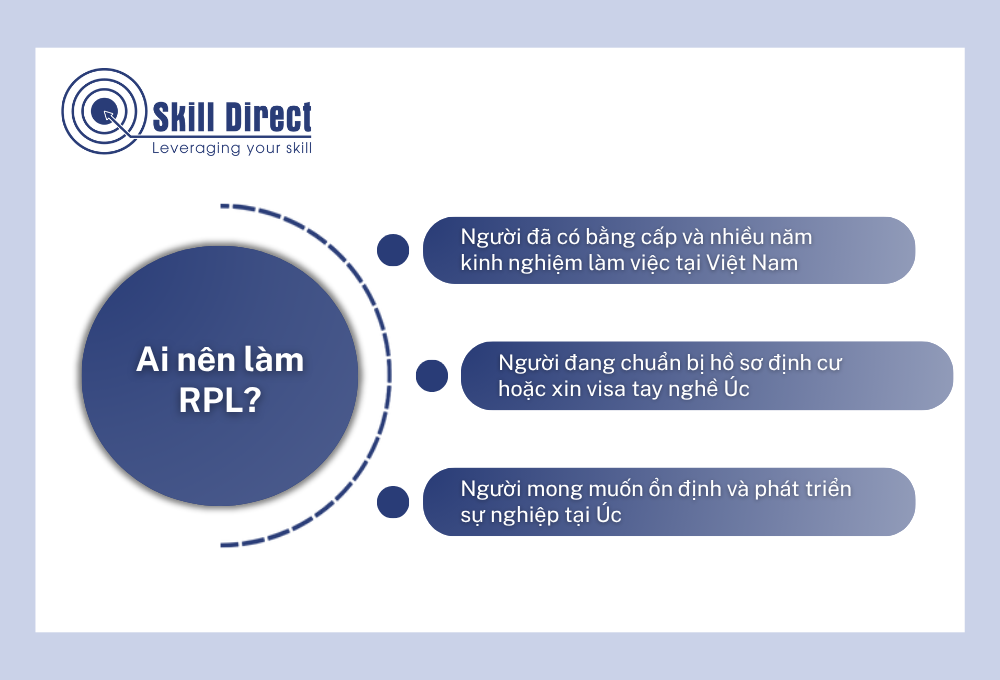
1.3 Who should do RPL?
RPL may be suitable for individuals who have substantial industry experience but do not hold an Australian-recognised qualification.Some people who should take RPL include:
- Experienced tradespeople and skilled worker: If you have worked for many years as a chef, electrician, plumber, mechanic, carpenter, aged care worker, or in another skilled occupation, but your qualifications are only recognised in your home country, RPL may help you obtain an Australian qualification that reflects your practical experience.
- Applicants preparing for Skills Assessment or skilled migration: Many skilled migration pathways require applicants to obtain a positive Skills Assessment. Depending on the occupation and assessing authority, an Australian-recognised qualification obtained through RPL may assist in satisfying qualification requirements. Nếu bạn chưa có, RPL chính là con đường ngắn nhất để hợp pháp hóa tay nghề mà không phải mất thêm vài năm học lại từ đầu.
- Individuals seeking long-term career development in Australia:RPL can help you access better employment opportunities, progress to higher-level qualifications, meet licensing requirements in certain occupations, and support your long-term professional development in Australia.
Completing RPL early may help streamline your migration and career planning process.
2. Which Industries Can Use RPL?
RPL is available across a wide range of industries in Australia and allows experienced workers to have their existing skills formally recognised. The assessment process is generally conductedby a Registered Training Organisation (RTOs) , which evaluates whether your knowledge and experience meet the competency requirements of a specific qualification.
Common industries include:
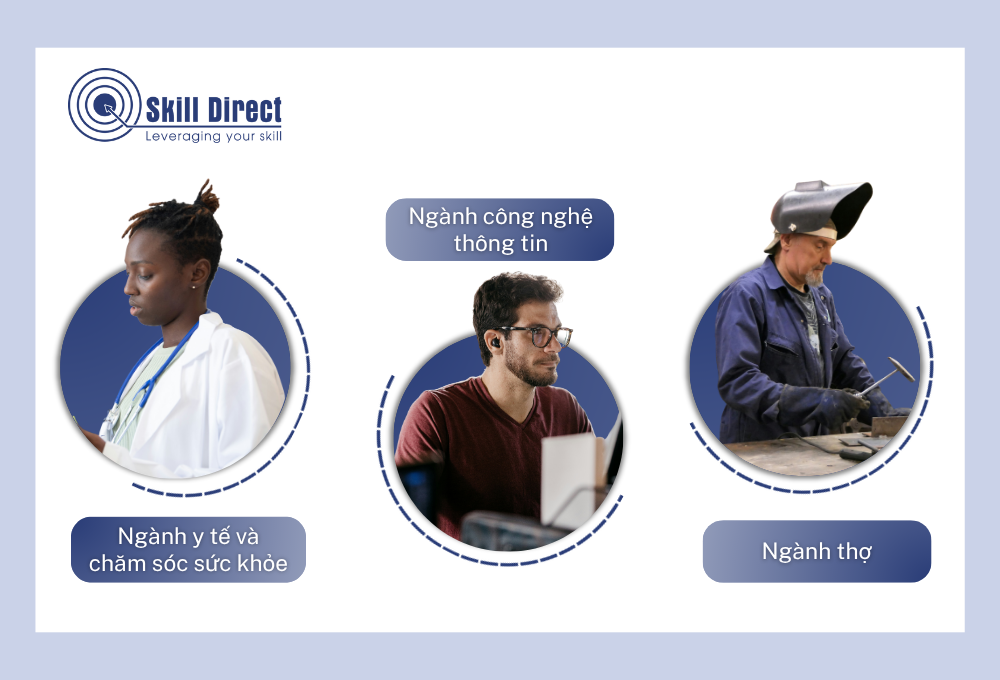
- Trade Occupations: cook, chef, carpenter, construction, electrical,.....
- Health and Community Services: Aged Care, disability Support, community Services, individual Support,....
- Information Technology: Programming, systems Administration, network Support, data Analysis, ......
For the Information Technology (IT) sector, apart from RPL, you should also familiarize yourself with the Acs Skills Assessment process to prepare the appropriate documentation if you plan to migrate through an ICT pathway.
Besides, RPL is also widely available in business, project management, education, hospitality and community service sectors.This helps workers shorten their career development path and increase their chances of working and settling in Australia.
The cost of RPL varies depending on the qualification level, occupation, RTO andthe scope of services included. Applicants should carefully compare providers before making a decision. Therefore, you should carefully compare the items included in the cost before choosing a provider for your RPL project.
3. Career Pathways After Obtaining an RPL Qualification
Securing your RPL certificate gives you a powerful launchpad to scale your career and make significant strides toward your PR goals. Here is a strategic roadmap for your post-RPL journey:
- Secure Professional Employment Aligned with Your Goals
You can confidently apply for roles that match your newly certified Australian trade qualification. This allows you to integrate rapidly into the Australian workforce, accumulate local work experience, and expand your professional network. - Upskill and Pursue Higher Qualifications
To stay competitive or earn higher points for your skilled visa, you can use your RPL certificate as a stepping stone to advanced diplomas or specialized degrees.Continuous upskilling enhances your professional profile in the Australian labor market. - Strategic Visa Planning
With your qualification in check, it is time to map out a clear PR pathway. Identify your visa options (such as the 189, 190, or 491) and ensure your occupation is listed on the relevant Skilled Occupation Lists (SOL). Concurrently, optimize other point-scoring factors such as English proficiency, regional employment, or professional year points.
Strategic Visa Planning - Launch Your Own Business or Venture
If you possess an entrepreneurial mindset and long-term career visions, starting your own business or registering a company in Australia is a highly viable path. Your RPL qualification will streamline the process of acquiring mandatory contractor licenses and legal business registrations.

4. The RPL Application Process
4.1 The DIY (Do-It-Yourself) Route
You can certainly manage the RPL application process independently by following these core steps:
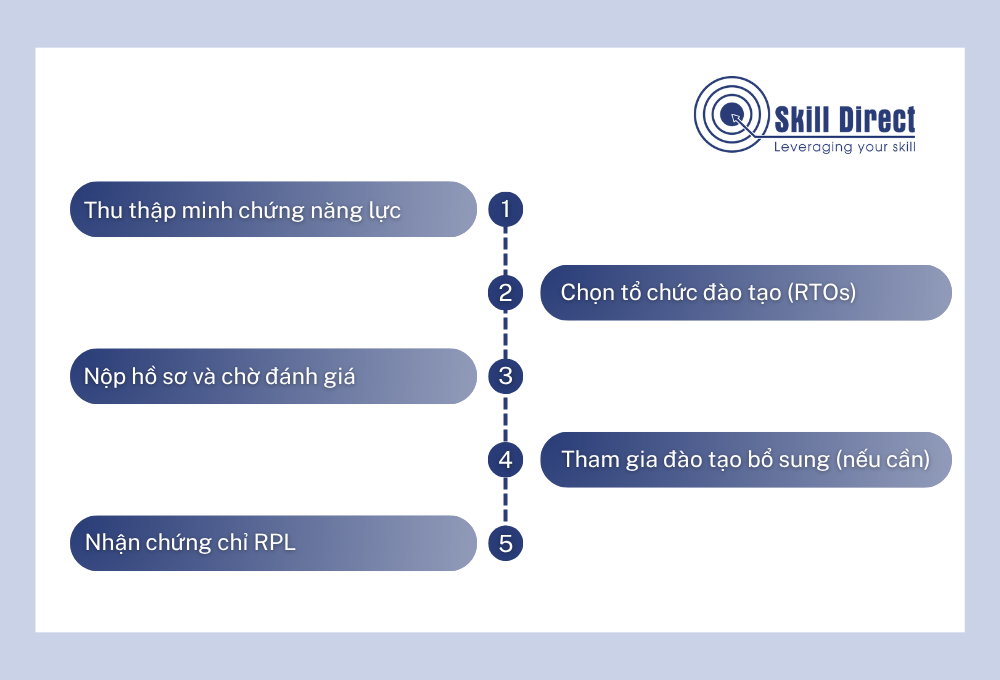
- Compile Competency Evidence: Gather comprehensive documentation proving your hands-on experience, including prior qualifications, academic transcripts, employment contracts, detailed job descriptions, workplace photos/videos, payslips, and reference letters from past employers.
- Select a Registered Training Organisation (RTO):: Source and contact an Australian-accredited RTO that has the scope and authority to assess and issue qualifications for your specific trade.
- Submit Portfolio for Skills Assessment: Submit your compiled evidence portfolio to the RTO for a formal desk audit and competency evaluation.
- Gap Training (If Required):: If the RTO identifies certain competency gaps that your evidence doesn't fully cover, they may require you to undertake short-term gap training to meet full qualification standards.
- Receive Your Australian Qualification: Once you successfully satisfy all competency benchmarks, the RTO will issue your official Australian Trade Certificate, which can be instantly deployed for employment, Skills Assessments, and visa pathways.
While navigating the DIY route gives you full control, it requires a thorough and precise understanding of each RTO's specific compliance audit framework before submission.
In addition to providing RPL support, Skill Direct also offers expert consultancy for VETASSESS Skills Assessmentapplications, helping you minimize common pitfalls and maximize your chances of securing a positive outcome on your first attempt.
4.2 Partnering with a Professional Agency
To ensure your skills conversion and migration timeline are optimized, error-free, and stress-free, partnering with an experienced, professional migration and education consulting firm is a highly strategic choice.
With experienced Registered Migration Agents in Australian migration, Skill Direct will demystify the complex RTO audit criteria, optimize every piece of your RPL evidence portfolio, and seamlessly bridge the gap between your current skill set and your dream career in Australia.


