



For many Vietnamese professionals and skilled workers, working in Australia has long been seen as an opportunity to achieve financial stability, build a successful career, and pursue permanent residency. From recent graduates to experienced tradespeople, Australia continues to attract migrants with its competitive salaries, strong employee protections, high standard of living, and world-class social welfare system. For many families, Australia's quality education system and long-term opportunities for future generations are equally important reasons for choosing to migrate.
However, with Australia's complex migration system, numerous visa options, hundreds of eligible occupations, and policy changes introduced regularly by the Department of Home Affairs, identifying the most suitable migration pathway can be challenging. In this guide, Skill Direct explains how to choose the right occupation, understand the available work visa options, and develop a sustainable pathway towards Australian permanent residency.

1. Why Is Working in Australia So Popular?
Australia consistently ranks among the world's most desirable countries to live and work. According to data compiled by Jobseeker According to data compiled from World Population Review and U.S. News & World Report, Australia is the second most searched country in the world for job opportunities, behind only Canada. Australia’s appeal as a destination for work is driven by three key factors: a strong economy, a high quality of life, and its people and multicultural society.
1.1 Competitive Salaries
ustralia offers some of the highest minimum wages in the world, making it an attractive destination for both skilled and semi-skilled workers. From 1 July 2026, Australia's national minimum wage increased to AUD 26.44 per hour, equivalent to 476.000 VNĐ/hour, and about AUD 1,004.90 per week (equivalent to 18 million VND).
Actual earnings are often significantly higher depending on an individual's occupation, qualifications, experience and location. For example, occupations such as: Welders, Chefs, Construction workers, Agricultural workers, Engineering technicians. commonly earn between AUD 55,000 and AUD 80,000 per year, with experienced workers often earning considerably more. With careful financial planning, many workers are able not only to cover their living expenses but also to build substantial savings while working in Australia.
Australia's relatively strong currency also provides additional financial advantages for migrants sending money home or building long-term wealth. Rather than simply earning a salary, working in Australia gives many migrants the opportunity to achieve financial goals such as purchasing a home, investing for the future, or supporting family members overseas.
For these reasons, Australia's combination of competitive wages, employee benefits and long-term earning potential continues to attract skilled workers from around the world.

1.2 A Professional Working Environment
Australia is widely recognised for its fair, inclusive and professional workplace culture. The Australian workplace places strong emphasis on the principle of a "fair go", meaning employees are expected to be treated equally and respectfully regardless of their background. Employers also value work-life balance, with full-time employees generally working around 38 hours per week. This allows workers to maintain a healthier balance between their professional and personal lives while spending more time with family. Australian workplaces are also subject to strict workplace health and safety legislation designed to protect employees.
In addition, Australian employment laws prohibit discrimination in the workplace. Employees who experience unfair treatment have access to legal protections and complaint mechanisms. Many Australian organisations also have relatively flat management structures, encouraging open communication, teamwork and collaboration across different departments. Overall, Australia's workplace culture provides an environment where skilled migrants can develop their careers while enjoying an excellent quality of life.
1.3 An Outstanding Quality of Life
For many migrants, working in Australia is about much more than earning a higher income. Australia consistently offers one of the highest standards of living in the world. Its healthcare system, including access to Medicare for eligible permanent residents and other eligible visa holders, provides affordable, high-quality healthcare services.
Australia's education system is another major advantage. For migrants planning to settle permanently and raise a family, Australia's public education system and internationally recognised universities provide excellent educational opportunities for future generations.
These advantages continue to make Australia one of the world's most attractive destinations for people seeking both career advancement and long-term lifestyle benefits.
2. Choosing the Right Occupation
The biggest mistake many people make is choosing a career in Australia based solely on personal preference, forgetting that market demand is the deciding factor in whether they have a chance of settling in Australia. Only when they want to stay and work in Australia do they discover that their chosen field is not among the priority occupations for Australian migration or has high recruitment demand. To successfully work in Australia and work towards permanent residency (PR), you need to choose what Australia needs, not just what you have.
2.1 Occupations with Strong Employment Demand
Trade Occupations
Trade occupations continue to experience significant workforce shortages across Australia and offer excellent opportunities for skilled Vietnamese workers.
- Chef/Cook: Australia is a paradise for tourism and cuisine, so the demand for Asian and European chefs is always very high. This is also a field with opportunities for stable employment and settlement.
- Baker/Carpenter/Bricklayer: any of these occupations remain eligible under Australia's skilled occupation lists (MLTSSL)and continue to provide strong long-term employment opportunities.
Education
Australia continues to experience teacher shortages across many states and territories.
- Early Childhood Teachers: This occupation is frequently included in the priority occupation lists of various states and territories.
- Secondary School Teachers: Especially in Mathematics and Science.
Nursing and Aged Care
Australia's ageing population continues to drive strong demand for healthcare professionals.
- Registered Nurse: This occupation group generally attracts strong migration points and may receive priority visa processing.
- Aged Care Worker: In recent years, Australia has expanded migration opportunities for aged care workers through Labour Agreements, creating additional pathways for workers with relevant vocational training and experience.

2.2 Visa Options That Allow You to Work Legally in Australia
To work in Australia, you must hold an appropriate visa with work rights. Never rely on claims that you can simply enter Australia as a visitor, work unlawfully and eventually obtain permanent residency after a few years. This does not provide a legitimate pathway to permanent residency and may result in visa cancellation, removal from Australia and, depending on the circumstances, an exclusion period that could affect future visa applications. Such consequences can significantly limit your future opportunities to live and develop your career in Australia.
Below are some of the most common visa pathways that allow eligible applicants to work in Australia and potentially progress towards permanent residency.
| Visa | Suitable for | Key Features |
| Subclass 491 - Skilled Work Regional (Provisional) | Skilled workers nominated by a state or territory government or sponsored by an eligible family member in regional Australia | Valid for 5 years. Requires living and working in designated regional Australia. Eligible applicants 3 years after meeting the relevant requirements, may apply for the Subclass 191 Permanent Residence (Skilled Regional) visa. |
| Subclass 190 – Skilled Nominated | Skilled workers nominated by a state or territory government | Permanent residence visa allowing holders to live, work and study anywhere in Australia, although applicants are generally expected to support the nominating state or territory. |
| Subclass 482 – Skills in Demand (SID) | Skilled workers sponsored by an approved Australian employer | Provides a pathway to permanent residency through the Subclass 186 Employer Nomination Scheme , subject to meeting the relevant eligibility requirements. |
These are only some of Australia's work visa options. The most suitable pathway depends on factors such as your occupation, qualifications, work experience, English language proficiency and long-term migration goals. If you would like personalised advice, Skill Direct can assess your profile and recommend the most appropriate migration strategy.
3. Factors That Can Strengthen Your Migration Prospects
Meeting the minimum visa requirements does not necessarily make an applicant competitive. To maximise your opportunities for employment and permanent residency, it is important to strengthen your overall migration profile.
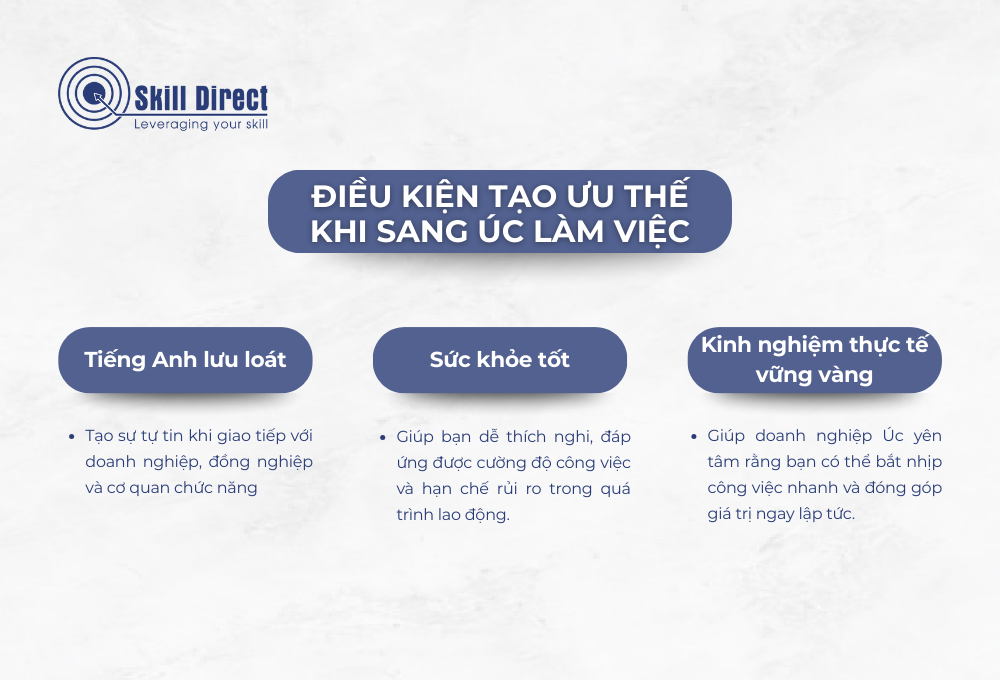
Strong English Language Proficiency: English language ability is one of the most valuable assets for anyone planning to work and settle in Australia. A higher English test score can: increase your Points Test score for skilled migration; improve your employment opportunities; help you communicate confidently with employers and colleagues; make it easier to understand your workplace rights and responsibilities; and support successful integration into Australian society. Investing in your English language skills is one of the most effective ways to improve your long-term migration prospects.
Good Health: Maintaining good health is equally important. Moving to a new country often involves adapting to a different climate, work environment and lifestyle. A healthy physical condition enables you to perform your job effectively and adapt more easily to life in Australia. Health requirements also form part of Australia's visa assessment process, making this an important consideration for prospective migrants.
Relevant Work Experience: Practical work experience demonstrates your professional capability and gives employers greater confidence in your ability to contribute from the outset. Applicants with substantial, relevant industry experience are generally more competitive in both the Australian labour market and skilled migration programs. Building solid work experience before applying can significantly improve your employment opportunities and long-term career prospects in Australia.
Strong English language skills, good health and relevant work experience together form a strong foundation for anyone seeking to build a successful future in Australia.
4. A Sustainable Pathway from Working in Australia to Permanent Residency
Working in Australia should be viewed as part of a long-term migration strategy rather than simply an opportunity for short-term employment. Developing a clear plan from the beginning can significantly improve your chances of achieving Australian permanent residency.
Stage 1: Build a Strong Foundation Before Moving to Australia
Preparation begins well before your departure. During this stage, you should focus on: improving your English language proficiency (such as IELTS or PTE); developing your professional skills; gaining relevant work experience; obtaining any required licences or qualifications;
preparing your finances; and seeking professional migration advice to develop an appropriate strategy. Working with an experienced migration consultancy such as Skill Direct can help ensure your application is properly prepared from the outset.
Stage 2: Enter the Australian Workforce
While living and working in Australia a subclass 491 or 482 visa, use this period to demonstrate your skills, comply with your visa conditions and Australian migration laws, build relevant work experience and meet your tax obligations. This can strengthen your position when pursuing eligible permanent or employer-sponsored pathways in the future. This is particularly relevant in 2026–27, with the Regional allocation decreasing from 33,000 to 14,110 places, while the Employer Sponsored allocation has increased from 44,000 to 58,040 places.
Stage 3: Continue Strengthening Your Migration Profile
Alongside gaining work experience, continue improving your English and look for legitimate opportunities to strengthen your skilled migration points. Depending on your circumstances, this may include gaining additional eligible skilled employment, completing eligible study in designated regional Australia for an additional 5 points, or obtaining a subclass 491 nomination or eligible family sponsorship for an additional 15 points.
Stage 4: Achieve Australian Permanent Residency
Once you satisfy the relevant eligibility requirements, you may be able to obtain Australian permanent residency through one of several pathways.
Common options include: Subclass 186 Employer Nomination Scheme, through employer sponsorship; or Skilled Independent visa (subclass 189), Skilled Nominated visa (subclass 190), or progressing from a subclass 491 visa to the Permanent Residence (Skilled Regional) visa (subclass 191).
A well-planned migration strategy from the beginning can shorten your pathway to permanent residency and maximise your long-term opportunities in Australia.