



Securing a positive VETASSESS Skills Assessment outcome is the foundational first step in your Australian skilled migration strategy. However, many applicants with extensive real-world work experience still encounter major hurdles, ultimately facing visa-shattering negative outcomes. Let’s join Skill Direct to unpack exactly why genuine experience can still result in a failed VETASSESS Skills Assessment!
1. What is VETASSESS?
1.1 Definition
VETASSESS is an authorized assessing authority appointed by the Australian Government to evaluate the professional and vocational skills of applicants seeking General Skilled Migration visas. This body is currently responsible for assessing 368 occupations, spanning highly specialized professional roles to various skilled trades.
VETASSESS acts as a critical screening gateway, determining whether your qualifications, core competencies, and employment background align with strict Australian occupational standards. Ultimately, this outcome dictates your eligibility to lodge an Expression of Interest (EOI) for permanent residency.
Unlike niche assessing bodies—such as the ACS, which exclusively assesses Information Technology (IT) roles, or CPAA, which manages accounting, auditing, and financial professions—VETASSESS handles a much broader remit. It governs the vast majority of non-IT/accounting professional careers and select trade streams within the Australian migration ecosystem.
1.2 VETASSESS Evaluation Criteria
During the assessment process, VETASSESS meticulously scrutinizes multiple variables to determine your suitability against Australian benchmarks. Every occupational category under VETASSESS enforces its own unique criteria regarding minimum qualifications and the number of years of post-qualification skilled employment required.
For instance, an applicant nominating Marketing Specialist must hold a Bachelor’s degree or higher in a highly relevant field (such as Marketing, Business, or Communications) and possess at least one year of highly relevant post-qualification work experience.
Furthermore, your academic background and professional credentials undergo rigorous country-specific profile checks. For example, a Bachelor’s degree earned in Vietnam must be mapped and assessed for its educational equivalence under the Australian Qualifications Framework (AQF) to guarantee that your foundations meet the technical demands of the local market.
1.3 VETASSESS Updates: What You Need to Know
One of the most notable VETASSESS changes in the 2026 financial year is the increase in Skills Assessment fees.
From ngày 9/9/2026, application fees for professional occupation Skills Assessments increased in line with inflation. This adjustment also applies to Priority Processing (PP), Skills Assessment Support (SAS), Chinese Qualification Verification (CQV), all Non-migration Skills Assessments, and administration fees.
However, the fee increase does not apply to Skills Assessments for trade occupations. The new fees have been adjusted in line with movements in the Consumer Price Index (CPI) and reviewed in accordance with Australian Government guidance to ensure they remain current and transparent.
Note: Applications lodged on or after 9 September 2026 are subject to the new fee schedule. View the latest fees
2. How Does VETASSESS Classify Occupations?
VETASSESS evaluates a massive spectrum of occupations for Australian immigration purposes. Broadly speaking, these roles are split into two major streams:: Professional Occupations (Professionals) and Trade Occupations (Trades).
2.1 Professional Occupations (Professionals)
VETASSESS currently assesses over 341 professional occupations across diverse industry sectors, focusing primarily on corporate, managerial, and highly specialized roles that demand advanced higher education..
Key occupations frequently assessed by VETASSESS include:
- Marketing Professional
- Management Consultant
- Café or Restaurant Manager
- Internal Auditor
Beyond these, VETASSESS also covers a multitude of roles within healthcare, retail management, education, scientific research, and human resources.... The exhaustive list of eligible occupations can be verified directly on the official of VETASSESS.
The process for submitting applications for skills assessment.
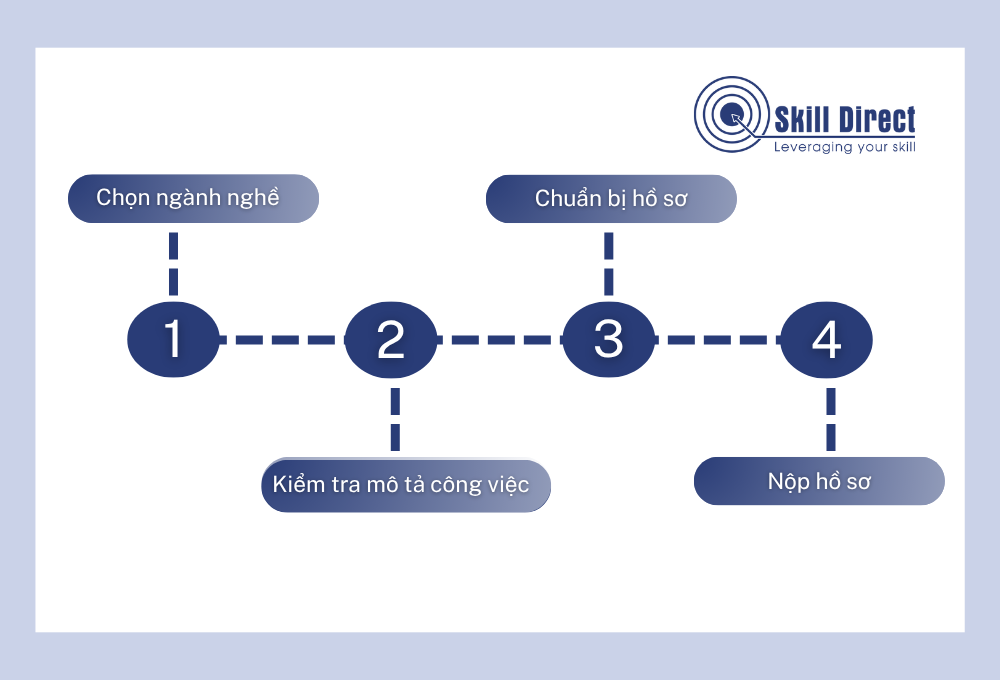
To complete your Application process, you need to follow these four basic steps :
- Identifying Occupation
Identify the profession you wish to be assessed for and carefully review the qualification and work experience requirements for that field. - Audit the Occupational Description
Read the job description on the VETASSESS website to compare it with your actual joband ensure that the duties and responsibilities match. - Documentation preparation
Gather all degrees, transcripts, employment references, and financial evidence. If you are uncertain about compliance, seeking professional advisory support at this stage is highly recommended.. - Apply Documentation
Complete and submit your application online through the VETASSESS skill assessment system to begin the skills assessment process.
Once lodged, you must actively track your file's status via the online dashboard,as processing turnarounds fluctuate based on the occupation group and seasonal volume.
2.2 Trade Occupations (Trades)
In addition to professional corporate streams, VETASSESS is also authorized by TRA Skill Assessment to assess 27 trades within the skilled worker category.
Prominent trade occupations under its jurisdiction include:
- Cook, Chef
- Electrician
- Motor Mechanic
- Welder
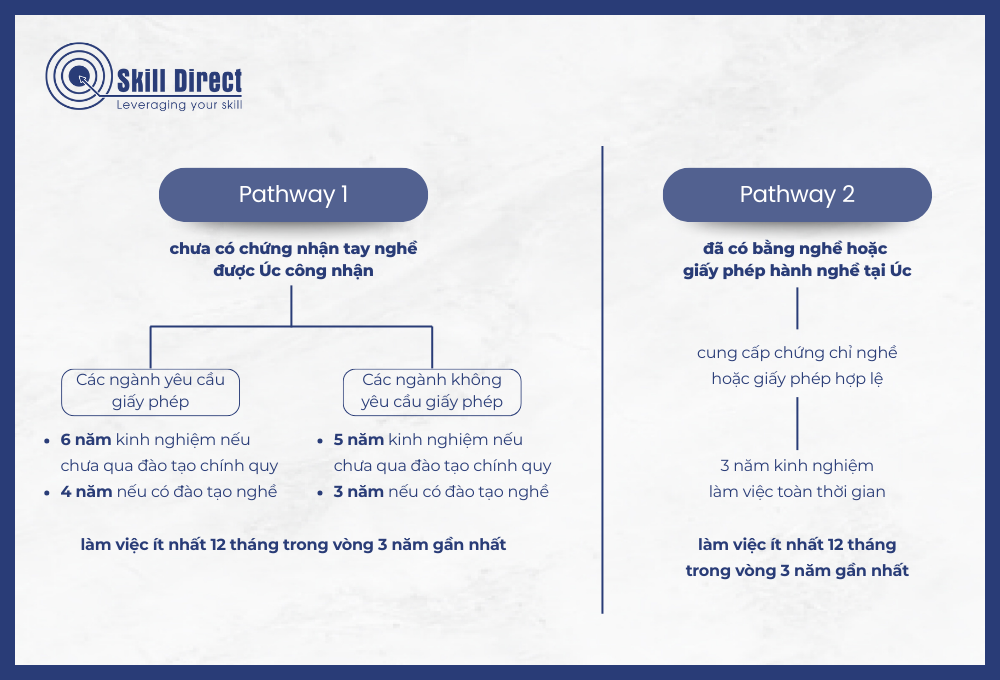
In the trades streams, the assessment body offers two options. You can choose either Pathway 1 or Pathway 2 depending on whether you already have a qualification or license to practice in Australia. The main difference between these two pathways lies in whether or not you have an Australian-recognized professional certification..
If you are eligible Pathway 1 - This pathway relies heavily on verifying your raw, practical work experience. For licensed trades, applicants must prove 6 years of work experience (without formal training) or 4 years (with relevant vocational training). For non-licensed trades, the threshold is 5 years of experience (without formal training) or 3 years (with relevant training). Crucially, you must also prove at least 12 months of employment within your nominated trade in the 3 years immediately prior to applying.
Pathway 2 This is tailored for applicants who already possess an Australian-accredited trade certificate or a valid Australian state/territory license. Applicants must supply their certified credentials alongside a minimum of 3 years of full-time, post-qualification employment, which must include at least 12 months of local or international experience within the last 3 years.
While the initial documentary lodgement process for trade streams mirrors that of the professional categories, there is a major structural difference: trade applicants must pass a mandatory (technical interview) . This interview evaluates your hands-on expertise, technical knowledge, and day-to-day operational safety skills directly with an Australian industry expert.
3. Why Can Real Work Experience Still Fail VETASSESS?
It is a common and frustrating paradox: many migration applicants possess extensive, genuine, and high-level industry experience, yet still receive a negative VETASSESS outcome. This leaves individuals bewildered as to why their real-world capabilities were deemed "not highly relevant" or non-compliant.
3.1 Common Compliance Pitfalls
Understanding these recurring transactional mistakes helps clarify why genuine employment can still face a VETASSESS rejection.
- Inadequate Primary and Secondary Financial Evidence: A common reason is a lack of documentation proving practical experience, such as letters of recommendation,, employment contracts, or payslips.In many cases, if the previous company has ceased operations or undergone restructuring, applicants may find it difficult to gather all the necessary paperwork.
- Non-Compliant Documentation and Poor Translation Standards: Documents that are blurry, unclear, or not properly translated may cause the reviewing agency to doubt the authenticity of the application. In some cases, applications have been rejected simply because the copies were not notarized or the translations were not certified.
3.2 Crucial Lessons to Take Away
These common failures prove that a successful VETASSESS outcome is not just about how talented you are or how many years you have worked—it hinges entirely on how effectively you present and prove that competence on paper. A well-structured, logical,and fully compliant portfolio and that aligns seamlessly with VETASSESS guidelines will always triumph over an unorganized experience.
The Australian Government maintains uncompromising integrity frameworks for skills assessments to ensure that incoming skilled migrants possess capabilities that perfectly match domestic industry standards.Consequently, every detail—from the wording of your job description to your financial evidence—must be transparent, authentic, and perfectly aligned with your ANZSCO code. A minor administrative discrepancy, or an overlap where your daily tasks drift away from the core requirements of your nominated occupation, can completely derail your file.

3.3 Expert Optimization Strategies from Skill Direct
If you lack absolute confidence in navigating this intricate process, engaging a registered migration consultant or a specialized skills assessment agency can dramatically optimize your file and secure a positive outcome on your first attempt.
According to the elite specialists at Skill Direct, conquering VETASSESS requires more than just doing the work; it requires strategically positioning and mapping your professional value across every single document.
Here are the top expert-backed strategies recommended by Skill Direct to build a professional and bulletproof VETASSESS application:
- Audit Your Educational Equivalence Early:
Before paying any assessment fees, verify exactly how your overseas qualification stacks up against the AQF system. Assuming that a foreign Bachelor’s degree automatically converts to an Australian Bachelor’s degree is a high-risk error. You must proactively evaluate your degree’s standing to avoid the risk of your entire work history being discounted due to an unsuitable qualification base. - Implement a Multi-Dimensional Evidence Strategy:
A clean, logically indexed portfolio leaves zero room for ambiguity. Beyond the mandatory standard documents, you should proactively inject secondary supportive evidence—such as comprehensive bank records showing clear salary streams, official employment contracts, organizational charts,and internal certificates of commendation. If your career spans multiple employers, organize your portfolio in strict reverse-chronological order,making it flawless for the VETASSESS officer to audit and verify.
If you want a comprehensive pre-assessment check and a personalized migration roadmap tailored to your specific profile, the dedicated Registered Migration Agents at Skill Direct is ready to streamline your journey toward your Australian permanent residency dream.